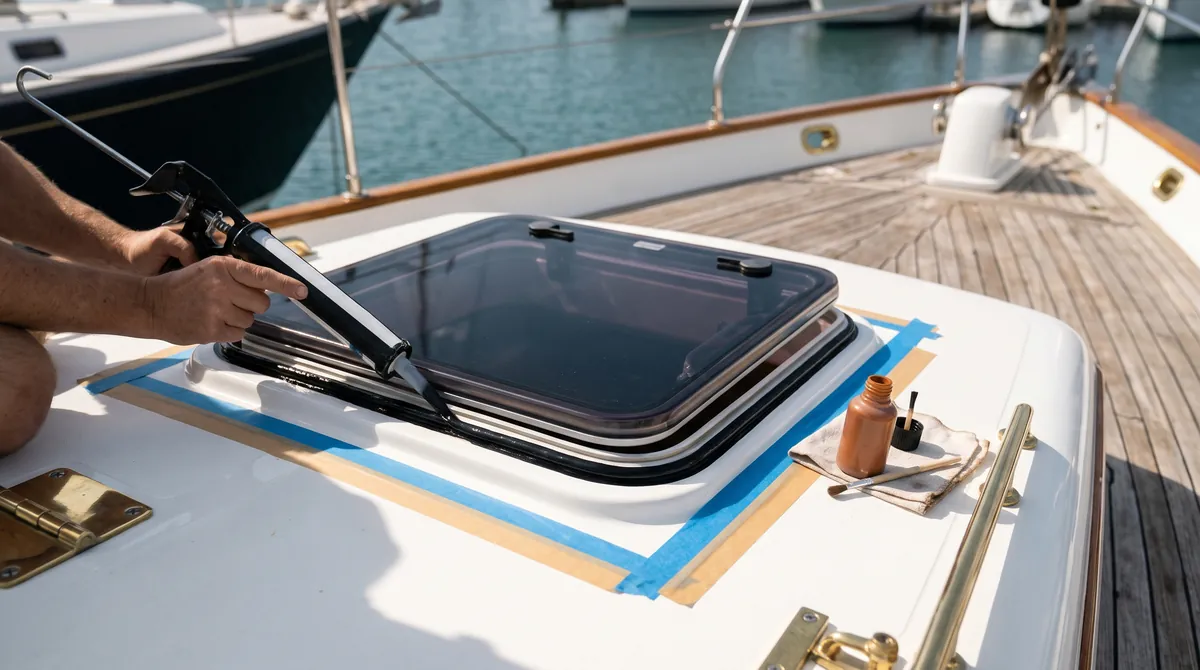
Rebedding deck hardware: stopping leaks before they start
Every stanchion, cleat and track is a hole through the deck. Sealed properly, it stays dry for many years; left to weep, it can rot the core beneath your feet.
Tap your way along a side deck with the handle of a screwdriver and the deck answers. Most of it rings sharp and solid. Then, around the base of a stanchion, the note turns dull, almost a thud. That small change in sound is often the first warning that water has been seeping past a fastener for years, softening the core under the gelcoat while the deck above still looks perfect.
Why holes are the weak point
Many GRP decks are sandwich constructions: two thin skins of laminate with a core of balsa or foam between them. The core makes the deck stiff and light, but it only works while it stays dry and bonded to both skins. Every fitting on deck (stanchions, cleats, tracks, windlasses and winches) is held by fasteners that pass straight through that sandwich. If the bedding fails, water follows the fastener into the core. Balsa soaks it up and eventually rots; foam resists water better but can still lose its bond, and the skins begin to separate in what is called delamination.
Signs of a leak
- Brown or rusty stains on headliners and around fittings below deck.
- Wet or sagging headliners and damp lockers after rain or washing.
- Soft or springy areas of deck underfoot, especially around fittings.
- A dull sound when tapping, where the rest of the deck rings solid.
- Cracks in the gelcoat radiating from the base of a fitting.
A moisture gauge confirms what tapping suggests, though readings need interpreting with care; a surveyor will compare them with known dry areas of the same deck. Leaks rarely stay where they start. Water can travel along the core before it shows, so the stain below may not sit directly under the guilty fitting.
Potting: sealing the core for good
Best practice is not simply to squeeze new sealant around the old holes. The aim is that water can never reach the core again, even if the bedding fails. Boatbuilders call this potting, and it follows a clear order:
- Remove the fitting and clean the old sealant off both the fitting and the deck.
- Check the core around each hole by tapping and with a moisture gauge.
- Drill the hole oversize through the top skin and into the core.
- Remove wet or soft core around the hole and undercut it slightly, often with a bent nail held in a drill.
- Seal the hole from below with tape, fill the cavity with thickened epoxy and let it cure fully.
- Re-drill the fastener hole through the cured epoxy, so the core is sealed behind a solid epoxy plug.
- Rebed the fitting with a suitable sealant and a backing plate below.
The aim is that water can never reach the core again, even if the bedding fails.
Where the core is wet over a larger area, potting a few holes is not enough. The wet section has to be opened from above or below, the rotten core removed, the laminate dried and new core bonded in before the skin is closed again. Recoring is structural work and belongs with a yard that has done it before.
Choosing the bedding
| Bedding | Character | Good for | Keep in mind |
|---|---|---|---|
| Butyl tape | Soft, stays flexible, does not cure | Fittings you may want to remove again, such as stanchion bases and tracks | Must be compressed gradually; it is a seal, not an adhesive |
| Polysulphide sealant | Flexible, cures to a rubbery seal | General bedding of deck fittings and wooden parts | Not suitable for some plastics; check compatibility |
| Polyurethane sealant | Cures with very strong adhesion | Permanent fittings that should never move | Makes later removal very hard and can damage gelcoat |
Always follow the sealant maker’s data on compatibility, primers and curing times.
Whatever you use, tighten the fasteners in stages. With butyl, nip them up, wait, then tighten a little more as the tape flows. With curing sealants, many experienced hands snug the fasteners lightly at first, let the sealant begin to cure, and then tighten fully, so a gasket of sealant stays under the fitting rather than being squeezed out completely.
Silicone is generally kept away from deck hardware. It is a poor adhesive for this kind of work, and its residue makes it very hard for any other sealant to bond to the surface later. Removing an old fitting that was bedded with a strong sealant needs patience: a thin blade or a length of wire worked slowly through the old bead, rather than a lever that cracks the gelcoat.
Backing plates and load
A fitting is only as strong as the deck that holds it. Washers alone concentrate the load on a small area and can crush the core or crack the skin. Backing plates of stainless steel or glass fibre laminate spread the load over a larger area and stiffen the deck around heavily loaded fittings such as cleats, stanchions and genoa tracks. When a fitting is off for rebedding, it is the right moment to add or enlarge a backing plate if it is missing or too small.
Windlasses, tracks and other special cases
Some fittings need extra thought. A windlass sits over a large cut-out and carries heavy, shock loads from the chain, so the core around it should be solid laminate or epoxy, and the deck beneath is often reinforced. Long tracks have many fasteners in a row, and a single leaking bolt can wet a long strip of core. Chainplates are a case of their own, because water there threatens the rigging as well as the deck, and they deserve inspection whenever they leak.
A season’s plan
Rebedding works best in dry weather or under cover, with the deck and core dry and the temperature within the limits of the epoxy and sealant. Many owners work through their fittings over a few seasons, starting with those that leak and those that carry the most load. Keep a simple record of which fittings were rebedded, when and with what. It saves guesswork later and is welcome information for a surveyor or a buyer.
Questions and answers
Can I just add sealant around a leaking fitting?
It may stop the drip for a while, but it does not fix the cause and can hide water still entering the core. The reliable repair is to remove the fitting, check and seal the core, and rebed it properly.
Is butyl tape good enough for deck hardware?
Butyl stays flexible and is easy to remove later, which many owners value for stanchions, tracks and similar fittings. It is not an adhesive, so it relies on good compression and sound fasteners.
Why is polyurethane sealant not always recommended?
It bonds very strongly, which suits permanent fittings, but it makes later removal difficult and can pull gelcoat away. For fittings you may want to remove again, a less adhesive bedding is usually wiser.
How do I know if the core is wet?
Tapping and moisture readings around fittings are the usual first checks, along with stains, soft spots and damp below deck. A surveyor can map the extent of wet core before any repair is planned.
Our articles are general information written with care. Intervals and figures are guide values; the maker’s manual, your flag state, classification society and insurer take precedence, and safety critical work belongs with qualified professionals.