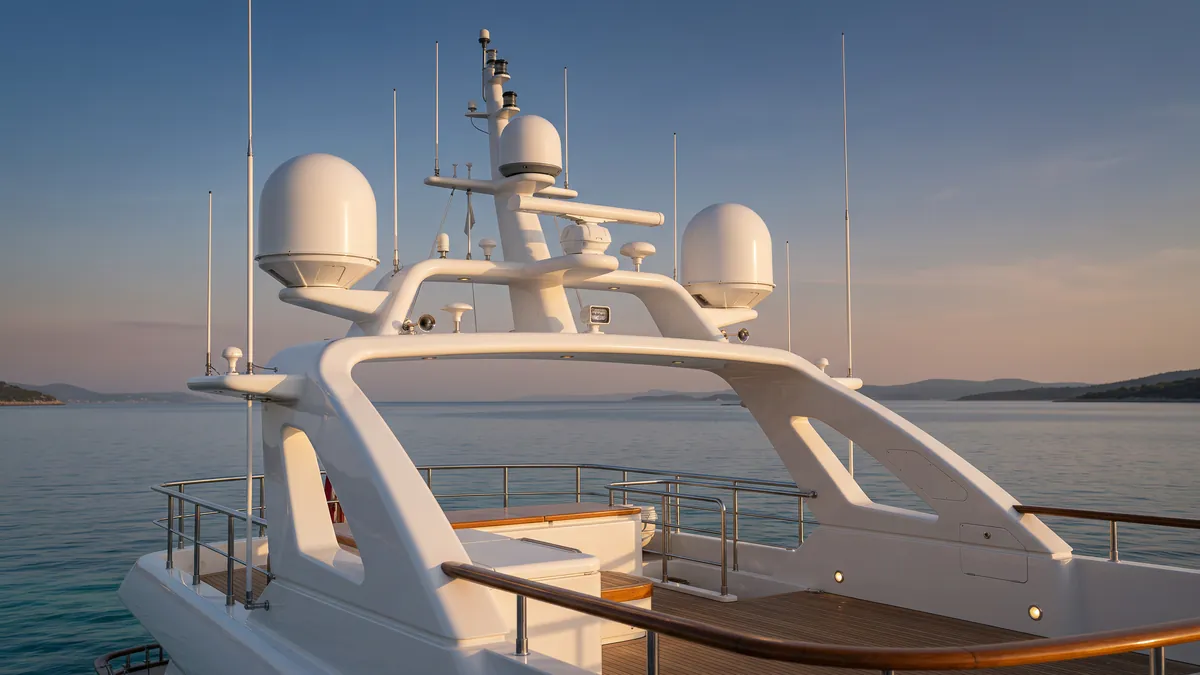
LED lighting on yachts: navigation lights, cabins and night vision
Light on a yacht has two jobs: to tell other vessels what you are doing, and to make life aboard calm and comfortable. LEDs do both well, provided they are chosen with care.
There is a moment on a night passage when the last lights ashore dip below the horizon and the yacht is left with its own: the red and green glow at the bow, a white gleam on the wake from the sternlight, the soft red of the chart table lamp below. Light on board does two very different jobs. Outside, it is a signal under international rules that other vessels read to understand what you are and what you are doing. Inside, it shapes how the cabin feels at the end of a long day.
Navigation lights and the COLREGs
Navigation lights must comply with the international collision regulations, the COLREGs, which set their colours, their arcs of visibility and their range according to the size and type of vessel. The arcs are precise, so that another vessel can tell from the lights it sees which way you are heading:
- Sidelights: red to port and green to starboard, each covering 112.5 degrees, from right ahead to 22.5 degrees abaft the beam.
- Sternlight: white, covering 135 degrees across the stern.
- Masthead light: white, covering 225 degrees forward, shown when a vessel is under power.
- Tricolour: sailing vessels under 20 metres may combine sidelights and sternlight in one lantern at the masthead, when under sail only.
- Anchor light: an all-round white light when lying at anchor.
The tricolour is efficient, because one lamp replaces three and it is seen from further away at the top of the mast, but it must be switched off the moment the engine is used for propulsion. The deck-level sidelights, the sternlight and the masthead light then take over. A clear switch panel with labelled circuits helps the crew get this right at three in the morning.
Choosing LED navigation lights
LEDs have changed navigation lights for the better: they use much less power than filament bulbs, produce little heat, cope well with vibration and last far longer. That makes a tricolour or an anchor light left on all night a far smaller load on the batteries. But a navigation light is a safety device, and it should be approved for the purpose, with the correct colour, arc and range for the size of your yacht.
Be cautious with LED bulbs fitted into old lantern housings. The housing, lens and light source were approved as a unit, and an LED bulb behind an old lens may not give the right colour, arc or intensity. It is better to replace the whole lantern with one approved for LED operation. Check its markings or papers for the approval and the vessel length it is meant for, and keep those papers on board, because a surveyor or an inspection at sea may ask for them.
A navigation light is not decoration; it is a sentence in a language every other vessel at sea understands.
Cabins: warm, dimmable and layered
Below deck, LEDs make it possible to light a yacht in ways that were never practical with bulbs. Warm white of about 2,700 to 3,000 K gives a comfortable, homely light that flatters wood and fabric, while cooler white looks clinical in a cabin and is better kept for the engine room and the workshop. Look for fittings with good colour rendering, so that varnished teak looks like teak and not like brown plastic.
Dimmers make a great difference. Bright light for cooking and cleaning, a lower level for the evening and very soft light for finding your way at night can all come from the same fittings. Layer the light: indirect strips under shelves and along the edge of the deckhead, reading lights at each berth, and task lights over the galley and the chart table. A few well placed sources often look better than a grid of downlights.
Night vision at the chart table and in the cockpit
The eye takes a long time to adapt fully to darkness and very little time to lose that adaptation. A single flash of white light at the chart table can leave the watchkeeper half blind on deck for many minutes. Red or strongly dimmed lighting at the chart table, in the companionway and in the cockpit preserves night vision. Fittings that switch between white and red are a practical answer, and instrument displays should have a night mode dim enough to read without glare.
Interference: the hidden side of LEDs
LEDs need electronic drivers to run from the yacht’s supply, and poorly filtered drivers can emit radio noise. On board this shows up as hiss or a raised noise level on the VHF radio, weaker reception of distant stations and AIS targets that appear late or not at all. The problem is easy to miss because it only affects weak signals. Choose marine quality fittings with proper filtering and test them: with the VHF on a quiet channel and the squelch open, switch the lights on and off one circuit at a time, listen for a change and watch whether AIS targets drop out.
LED fittings should also tolerate the full voltage range of the boat, which rises well above 12 V while the batteries are charging. Cheap fittings can flicker, run hot or fail early when they see charging voltages for hours on end.
Deck lights and underwater lights
Spreader lights and deck floodlights are invaluable for work on deck at night and for coming alongside in the dark, but they must be switched off under way, because they dazzle the crew and can drown out the navigation lights for other vessels. Underwater lights, fitted through or onto the hull below the waterline, turn an evening at anchor into a quiet spectacle. They are an opening in the hull like any other, so plan their installation with the yard during a haul-out, and follow the maker’s advice on running them out of the water, since many rely on the sea for cooling.
Questions and answers
Can I put LED bulbs in my old navigation lights?
Such bulbs are sold, but the lantern was approved as a unit with its original light source, and an LED bulb may change the colour, arc or intensity. Replacing the lantern with one approved for LED use is the safer choice.
When may I use the tricolour?
Sailing vessels under 20 metres may show a combined tricolour at the masthead when under sail only. As soon as the engine drives the boat, switch to the sidelights, sternlight and masthead light.
Why is red light used at night?
Red light disturbs the eye’s adaptation to darkness far less than white light, so the crew keep their night vision when they come back on deck. Strongly dimmed lighting helps in the same way.
How do I know if my LEDs interfere with the radio?
Listen to the VHF on a quiet channel with the squelch open and switch the lights on and off one circuit at a time. If the noise changes or AIS targets disappear, that circuit has a fitting with poor filtering.
Further reading in our network
- MurosoArchitecture and interiors
Architecture and interiors, with ideas on light, materials and calm rooms that translate well to a yacht’s saloon.
Our articles are general information written with care. Intervals and figures are guide values; the maker’s manual, your flag state, classification society and insurer take precedence, and safety critical work belongs with qualified professionals.