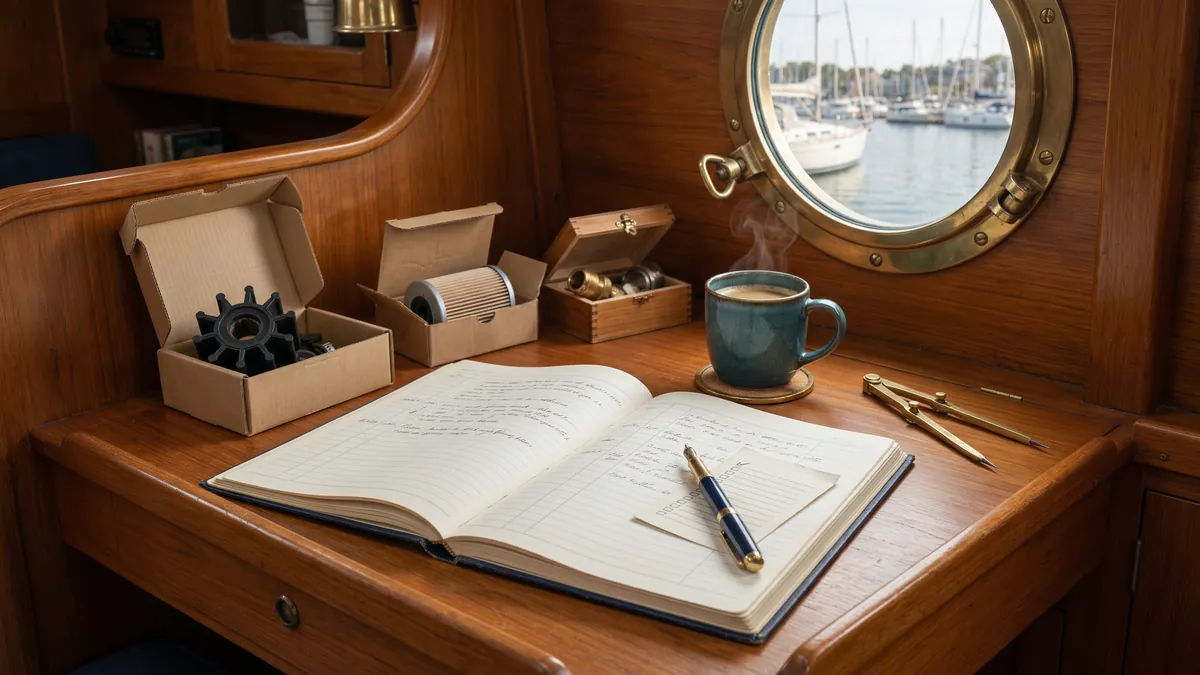

The yearly maintenance plan: calm instead of surprises
Calendar dates, running hours and honest condition checks: how a written plan turns the yacht’s year into a calm rhythm of small jobs instead of a run of expensive surprises.
In a small office above the shed, a ring binder lies open beside a mug of coffee gone cold. Inside are the yacht’s years in pencil: the date the cutlass bearing was renewed, the hours on the generator when its belt was last changed, a photograph of an anode half eaten after one summer. Nothing in it is dramatic, and that is the point. A yacht that is maintained to a plan rarely surprises its owner, and when something does go wrong, the plan usually shows why and what comes next.
What a maintenance plan actually is
A maintenance plan is a list of every system on board, each with its tasks and the interval at which they fall due. It sounds bureaucratic, but in practice it is simply the yacht’s memory written down. Engines, generators, steering, through hulls, rig, sails, canvas, electrics, gas, water, heads, safety equipment and the hull itself all get a line. Each line answers three questions: what needs doing, when it was last done, and what will trigger the next time.
The value lies less in the document than in the habit it creates. Owners who keep a plan tend to notice small changes early, a belt that squeals a little, a seacock that turns stiffly, a damp patch in a locker, and they deal with them while they are still small jobs. Regular small jobs prevent big ones, and they are far easier to fit around a season than an emergency haul out in the middle of July.
Three kinds of interval
Not every task runs on the same clock. Sorting the tasks by what drives them makes the plan much easier to read and keeps you from changing parts too early or, more often, too late.
- By calendar. Tasks that fall due on a date whatever the yacht has done: the yearly antifouling, service dates for life rafts, flares, fire extinguishers and lifejackets, certificates and registrations, and the age of gas hoses and standing rigging.
- By running hours. Engines and generators wear with use, so oil and filter changes, impellers, belts and other service items follow the hour counter and the maker’s schedule, usually with a time limit as well for boats that run little.
- By condition. Some things last as long as they last: anodes, teak decks, canvas, sealant, varnish and upholstery. They are inspected at set points and renewed when they reach a defined state, such as an anode worn to about half its original size.
| System | Typical trigger | Guide value |
|---|---|---|
| Antifouling | Calendar | Usually once a year, before launch |
| Gas hoses | Calendar | Renewed in good time, often after about five years or as marked on the hose |
| Engine oil and filters | Running hours and calendar | At the maker’s interval, and before the winter lay up |
| Raw water impeller | Running hours or calendar | Often every season, sooner if the pump has run dry |
| Fuel filters | Running hours and condition | At the maker’s interval, and whenever the fuel looks dirty |
| Anodes | Condition | Checked at every haul out, renewed when about half worn |
| Safety equipment | Calendar | By the service date on each item |
Guide values only. The maker’s manual, the flag state, the classification society and the insurer always take precedence.
The seasonal rhythm
Most plans hang on the shape of the year. In autumn the yacht is hauled out and winterised, which is the moment to look closely while the hull is clean and the season’s wear is still fresh in everyone’s mind. Winter belongs to the bigger works and any refit, done under cover where possible and with time to wait for parts. Spring is commissioning: systems are brought back to life, tested and signed off before launch. During the season, short regular checks keep things honest: a look into the engine bay before each passage, the bilge, the stern gland, the rig at the dock.
In the Mediterranean, where many yachts stay afloat or are hauled only briefly, the rhythm shifts but does not disappear. The quiet months still carry the heavy work, and a short haul out for antifouling and anodes becomes the fixed point around which everything else is planned.
Tools that keep it simple
You do not need special software. A logbook or a plain spreadsheet with dates and hours does the job, as long as it is kept up to date. What matters is that every entry records the date, the engine hours where relevant, what was done, who did it and which parts went in.
- A logbook or spreadsheet with one line per task, the last date, the last hours and the next trigger
- Photographs before and after each job, dated, so you can compare an anode, a hose or a sealant joint year on year
- A parts list with part numbers, filter sizes, impeller types, belt lengths and the spares carried on board
- The maker’s manuals collected in one place, on paper aboard and as copies ashore
- A folder of invoices and certificates, which also helps when the yacht is surveyed, insured or sold
Budgeting time as well as money
Owners tend to budget money and forget time. Yet time is often the scarcer resource: yard slots in spring fill quickly, specialist trades book weeks ahead, and paint and varnish need dry, settled weather between coats. A good plan lists not only what needs doing this year but roughly how many working days each job takes and which jobs depend on others. The engine cannot be aligned before the yacht is afloat, and the deck cannot be varnished while the rig is being worked on overhead.
Spreading larger tasks over several years helps too. If the standing rigging, the sails and the upholstery are all approaching the end of their lives, the plan shows it early, and you can decide calmly which comes first instead of facing all three in the same spring.
A yacht that is maintained to a plan rarely surprises its owner.
When someone else runs the plan
For owners who are often away, a yacht manager or a captain can run the plan from day to day. The arrangement works best when responsibilities are written down: who orders parts, who books the yard, who approves work beyond an agreed scope and how findings are reported. Short monthly updates with photographs keep the owner close to the boat without having to be there.
Whoever holds the plan, it should belong to the yacht rather than to one person. A captain may move on and a manager may change, but a complete record stays aboard and passes with the boat. Buyers and surveyors read it closely, and a yacht with a full history usually changes hands with fewer questions.
Starting from scratch
If there is no plan yet, begin with one honest walk round the boat with a notebook. List every system, find its manual, note what you know about its last service and mark the unknowns. Those unknowns are the first year’s work: change the impeller you cannot date, inspect the hoses with no record, have the gas system checked by a qualified person. After one full season the plan has a date against almost everything, and from then on it largely runs itself.
Questions and answers
How detailed does a maintenance plan need to be?
Detailed enough that someone else could pick it up and know what is due. One line per task with the last date, the last running hours and the next trigger is usually sufficient. Detail grows naturally as you add part numbers and photographs.
Should I follow running hours or the calendar for the engine?
Both. The maker’s manual usually gives an hour interval and a time limit, whichever comes first. Yachts that run few hours still need oil and filters changed regularly, because used oil ages and holds acids even when the engine rests.
Can a yard keep the plan for me?
Many yards keep records of the work they do, but a plan covering the whole yacht is best held by the owner, the captain or a yacht manager. Ask the yard to report every job in a form you can add to your own record.
What if I do not know when something was last serviced?
Treat it as due. An unknown date is the most useful entry in a new plan, because it tells you exactly where to start in the first year.
Further reading in our network
- conciarisLuxury concierge and lifestyle
Concierge and lifestyle services for owners who want the practical side of life on and off the water taken care of.
Our articles are general information written with care. Intervals and figures are guide values; the maker’s manual, your flag state, classification society and insurer take precedence, and safety critical work belongs with qualified professionals.