
Haul out: travel lifts, slings, cradles and stands
The few minutes when a yacht hangs in the slings are the most delicate of her year ashore. Good preparation, the right support and a careful first look make them routine.
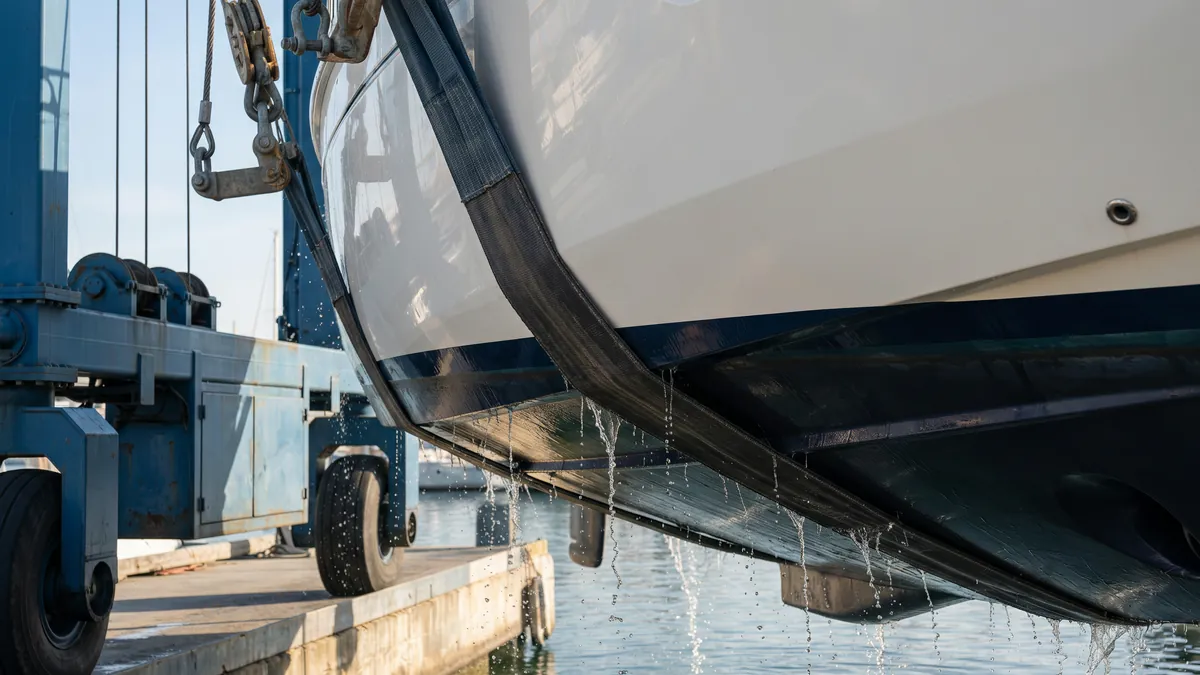
The travel lift creeps forward over the dock with a low hydraulic whine, its slings hanging slack in the water like two dark ribbons. One yard hand watches the bow, another the stern, and the owner stands a little apart, aware that the boat is briefly in other hands. Then the slings tighten, the waterline rises out of the harbour streaming weed, and for a moment the yacht hangs in the air, dripping and completely exposed. It is the most delicate few minutes of her year ashore.
Ways to lift a yacht
Most yachts within a certain size come out with a travel lift, also called a boat hoist: a gantry on wheels that drives over a lifting dock and raises the boat in broad slings. Mobile cranes do the same job where there is no lifting dock, lifting with a spreader beam so the slings pull straight up. Hydraulic trailers carry smaller and mid-sized yachts up a ramp and set them on stands without slings at all. For larger and heavier yachts, slipways and ship lifts take the weight on a cradle or platform, with the yacht floated over it and drawn out of the water.
| Method | How it works | Typical use |
|---|---|---|
| Travel lift | Mobile gantry lifts the yacht in slings from a lifting dock | Sailing and motor yachts within the lift’s capacity |
| Mobile crane | Lifts in slings with a spreader beam | Sites without a lifting dock, smaller yachts, mast work |
| Hydraulic trailer | Slides under the hull and raises it on pads | Small and mid-sized yachts, moves within the yard |
| Slipway | Cradle on rails drawn up out of the water | Heavier yachts and traditional yards |
| Ship lift | Platform raised vertically with the yacht on a cradle | Larger yachts beyond the reach of travel lifts |
Capacities and methods vary from yard to yard. Ask what is available for your yacht’s weight and dimensions.
What the yard needs to know
A smooth lift starts with numbers. Tell the yard the yacht’s weight as loaded, her overall length, beam and draught well before the date, and mention anything unusual: a long fin keel, a lifting keel, a bowsprit, stabiliser fins or a bathing platform. Loaded weight matters, because full tanks, stores and gear add a good deal to the figure on paper.
Below the waterline, the slings must avoid anything they could crush or bend. Many builders mark sling positions on the hull, often with a small symbol near the sheerline. If yours are not marked, find them in the builder’s documentation or ask a yard that has lifted the boat before, and mark them yourself. Know exactly where the propeller shaft, the transducers, the saildrive and any log or depth sensors sit, so the slings can be placed clear of them.
- Weight, length, beam and draught passed to the yard in writing
- Sling positions marked on the hull, or known from the builder’s plans
- Shaft, transducers, saildrive and sensors located and pointed out
- Backstay or forestay tension eased where the lift’s frame would foul it
- Loose gear stowed, fenders and lines ready for the lifting dock
On a sailing yacht, the frame of the lift may foul the backstay or the forestay. Where that happens, the tension is eased or the stay is disconnected for the lift, with the mast held by the remaining rigging. Agree in advance who does this and who puts it back afterwards.
On the hard: keel, stands and cradles
Once ashore, a sailing yacht’s weight rests on the keel, not on the stands. The keel is blocked on solid timber laid level on firm ground, and the stands only keep the boat upright. They are placed under strong points of the hull, padded and adjusted so that they touch firmly without pressing in. Stands are chained together in pairs across the boat, so that neither can creep outwards in a strong wind or when the ground softens.
Motor yachts, with their wider and flatter hulls, often sit on purpose-built cradles or on blocks under the keel line with supports along the bilges. A cradle made for the hull spreads the load well and makes later moves around the yard easier. Whatever the support, it should be checked after strong winds and long periods of rain.
Once ashore, a sailing yacht’s weight rests on the keel, not on the stands.
Washing and the first look
Ask for a pressure wash straight after lifting, while the yacht still hangs in the slings or as soon as she is on her stands. Weed, slime and barnacles come away easily while they are soft and wet. Left to dry in the sun, they set like cement and take hours to scrape. Keep the lance at a sensible distance from soft antifouling, gelcoat edges and sensors.
Then look closely, while the hull is clean and before anything is painted over. Walk round the boat slowly. Check the keel joint for cracks or weeping, the rudder for play in its bearings, the propeller for damage and the cutlass bearing for movement, the anodes for how much is left, and every through hull for growth and corrosion. Record blisters, scrapes and stains with photographs. These few minutes decide much of the winter’s work list.
Safety on the hard
A yacht on stands is stable, but she is not designed to be climbed on casually. Never go aboard without the yard’s permission, and only by a secure ladder that is tied to the boat and stands on firm ground. Do not adjust, move or remove stands yourself: if one needs to come away for painting, the yard moves it and sets another in its place. Keep well clear of the slings and the load during any lift, and leave the lifting itself entirely to the yard’s trained operators.
The same care applies when the season comes round and the yacht goes back in. Re-check the sling marks, make sure nothing has been fitted below the waterline in the meantime that the yard does not know about, and be there when she is lifted, so that any question can be answered on the spot.
Questions and answers
Who is responsible for placing the slings?
The yard and its lift operator place the slings and carry out the lift. The owner’s part is to provide accurate information and to point out the shaft, transducers and other fittings below the waterline.
Can I stay aboard during the lift?
No. Yards do not allow anyone aboard while a yacht is lifted or moved, and you should keep well clear of the lift and the load.
Why are stands chained together?
Chaining the stands in pairs across the hull stops either one from creeping outwards in wind or on soft ground. It keeps the support stable for the whole time ashore.
How soon should the hull be washed?
Immediately after lifting, while the growth is still wet and soft. Once it dries in sun or wind, it hardens and becomes far more difficult to remove.
Our articles are general information written with care. Intervals and figures are guide values; the maker’s manual, your flag state, classification society and insurer take precedence, and safety critical work belongs with qualified professionals.