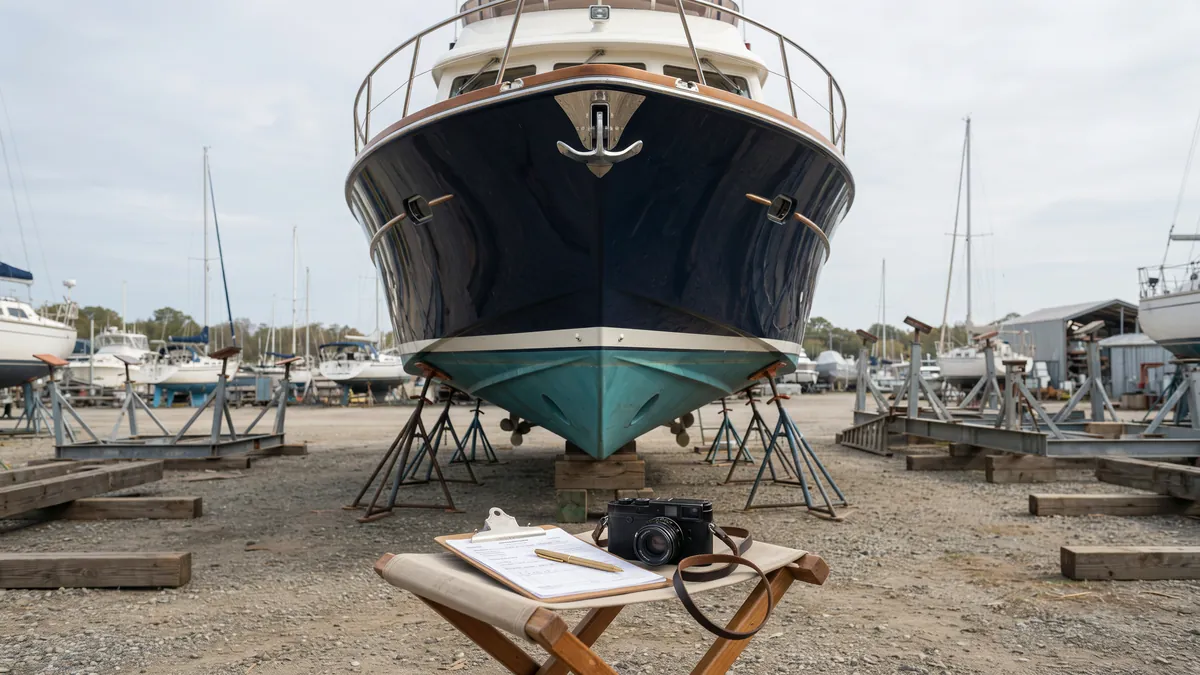

Spring commissioning: a checklist before you launch
From greased seacocks to a burped shaft seal and a first short sail: the checks that turn a yacht from winter storage into a boat you can trust with guests aboard.
On the first warm days the yard wakes up. Covers come off with a damp, sour breath of winter, radios play on stepladders, and the air smells of fresh antifouling and an outboard being tested somewhere across the hard. It is tempting to hurry. The weather is kind, the launch date is booked and the season is so close you can hear it in the halyards. Yet the hour you spend on a seacock now is worth a day of trouble in July.
Under the hull before launch
Start below, where you will not be able to reach again until the next haul out. Antifouling must be applied within its launch window, the time between the last coat and immersion that the paint maker specifies: launch too soon and the paint may not have dried enough, wait too long and some types lose part of their effect. Anodes on the shaft, propeller, saildrive, trim tabs and hull should be new, with clean contact surfaces that have never been painted over.
- Operate every seacock fully open and closed several times and grease it as the maker recommends. A valve that will not turn is a valve that will not close in an emergency.
- Check every hose clamp below the waterline for corrosion and tightness. Double clamps on hoses below the waterline are good practice where the hose tail is long enough.
- Inspect the shaft seal, or the saildrive seal and gaiter, against the maker’s inspection and renewal intervals.
- Check the propeller for damage and the cutlass bearing for play by moving the shaft firmly by hand.
- Check the rudder bearings for play, and the rudder itself for cracks or weeping around the stock.
Engine and batteries
Recommission the engine according to the manual. If the raw water circuit was protected with antifreeze, it will be flushed out on the first run; if it was drained, close the drain cocks and refit any hoses taken off in autumn. Fit a fresh impeller if one is due, or if the old one has sat in its housing all winter, since rubber vanes take a set and crack. Check the belts for tension and wear, the coolant and oil levels, the fuel filters, and the exhaust hose with its clamps.
Batteries should be fully charged and connected, with clean, tight terminals. Switch on the charger and the main systems one at a time and watch for anything unusual: a breaker that trips, a pump that runs without stopping, a smell of warm insulation. Anything of that kind belongs with a qualified marine electrician before the yacht leaves the yard.
Safety gear, gas and rig
Before launch, the safety equipment should be within its service dates: life raft, lifejackets and their gas cylinders, flares, fire extinguishers, the emergency position beacon and the first aid kit. Have the gas system leak checked by a qualified person when your plan calls for it, and at the very least test the gas alarm and look at the hoses and the dates printed on them.
On a sailing yacht, the rig is often stepped in spring, or comes back to life after a winter standing. Tune the shrouds and stays evenly, check every clevis pin and split ring, tape over the rings so they cannot snag sails, and make sure the halyards run freely. A look aloft by someone who knows rigs is worthwhile after any winter spent in the open.
The hour you spend on a seacock now is worth a day of trouble in July.
In the slings and afloat
The minutes after launch are for looking, not for leaving. While the yacht is still in the slings or tied up alongside the lifting dock, go below with a torch and check the bilge and every through hull, the shaft seal, the saildrive seal, the heads intakes and the water heater fittings. A small weep now is easily dealt with while the lift is still close by.
Dripless shaft seals of the mechanical face type usually need to be burped after launch, which lets trapped air escape so that water can reach and lubricate the sealing faces. The maker’s instructions describe how this is done for your seal. Then run the engine, check that cooling water flows at the exhaust straight away, and watch the temperature gauge for the first minutes.
Engine alignment is best checked after a few days afloat, once the hull has settled into its floating shape. Test the electronics, instruments, autopilot, navigation lights and bilge pumps. Hoist and inspect the sails, and look over the sheets and running rigging for wear.
- Bilge dry, every through hull checked by eye and hand
- Shaft seal burped and dry, saildrive seal dry
- Cooling water flowing at the exhaust
- Alignment check after a few days afloat
- Electronics, lights and bilge pumps tested
A first short sail
Before guests come aboard, take the yacht out for a first short sail with a small crew in settled weather. Run the engine under load, put the steering hard over in both directions, sail on both tacks, tuck in a reef, use the windlass, the heads and the galley. Then come back, open the engine bay and the bilge again, and look. Small things show themselves in that first hour: a hose that weeps under vibration, a halyard that chafes, a locker that lets in water when heeled.
Around Mallorca and elsewhere in the western Mediterranean, spring is a gentle time for that first outing. Harbours are quiet, the hills behind the coast are still green, and short passages between bays in light morning breezes let you test everything without pressure, long before the busy summer weeks.
Whatever turns up goes on the list, and most of it is quick to fix while the yard is still close at hand. After that, the yacht is ready for the season and for the people you want to share it with.
Questions and answers
How long can antifouling stand before launch?
It depends on the paint. Each antifouling has a launch window given by its maker, with a minimum drying time and, for many types, a maximum time before immersion. Check the data sheet and plan the launch date around it.
Why check alignment after a few days afloat?
A hull changes shape slightly between standing on its keel ashore and floating. Checking engine to shaft alignment once it has settled gives a true reading and protects the shaft seal, the cutlass bearing and the gearbox.
Do I need double hose clamps below the waterline?
It is widely regarded as good practice on hoses below the waterline, provided the hose tail is long enough for two clamps. The builder or a surveyor can advise on your particular fittings.
What should a first short sail include?
The engine running under load, steering hard over both ways, sailing on both tacks, a reef, the windlass, the heads and the galley. Afterwards, check the engine bay and the bilge again for leaks.
Further reading in our network
- island mallorcaThe island atlas
The island atlas of Mallorca, for owners planning their first spring passages along its coves and harbours.
Our articles are general information written with care. Intervals and figures are guide values; the maker’s manual, your flag state, classification society and insurer take precedence, and safety critical work belongs with qualified professionals.