
Running rigging: ropes, cores, splices and chafe
Halyards and sheets work harder than almost anything on deck. Understanding cores and covers, spotting chafe early and choosing splices over knots keeps them reliable.
Run a halyard slowly through your hands as it comes off the winch and you learn a great deal. A healthy rope feels even and supple, its cover firm against the core. A tired one has flat spots where it has lived for months in a clutch, a fuzzy patch where it rubs on a sheave, a stiff, shiny section where it once surged around a hot drum. Running rigging tells you its condition plainly, if you take the time to feel it.
What running rigging does
Running rigging is everything that moves: halyards that hoist the sails, sheets that trim them, and the control lines and reefing lines that shape and shorten them. Unlike standing rigging, it is handled constantly, runs through blocks, clutches and winches under load, and lives in sun and salt. It wears out sooner, which is exactly why it rewards regular attention.
Cores and covers
Most modern yacht ropes are double braids: a braided core that carries the load inside a braided cover that protects it and provides grip. Polyester double braid is the all-rounder, easy to handle, reasonably low in stretch and kind to the hands, and it remains the sensible choice for many sheets and control lines on cruising yachts.
Where stretch matters most, on halyards especially, cores of HMPE (high modulus polyethylene) give a rope that hardly lengthens under load, so the sail holds its shape as the wind rises. The cover then has a different job: it must grip in clutches and on winch drums and resist abrasion, so it is made of polyester or high performance blends. Matching the cover to the hardware matters as much as the core, because a slippery cover can let a loaded halyard slip through a clutch.
How ropes fail
Ropes rarely break without warning. They wear in predictable places and in predictable ways:
- Chafe at sheaves, fairleads, blocks and the lips of clutches, where the cover rubs repeatedly in the same spot.
- UV damage on the exposed parts of sheets and halyards, which turn faded, brittle and hairy.
- Cover slippage, when the cover creeps along the core and bunches up, often near a splice or where a clutch grips.
- Glazing from heat, when a rope surges around a winch or through a clutch and the fibres partly melt into a hard, shiny section.
Any of these can weaken a rope well before it looks ruined. A cover worn through to the core, a glazed patch or a section that feels stiff and lumpy needs attention, either by cutting out the damaged part, moving the wear point or replacing the line.
Care that adds seasons
Salt crystals act like fine sandpaper inside a rope, and grit does the same. Soaking lines in fresh water from time to time and then rinsing them keeps them supple and slows internal wear. Dry them fully before storage, coiled loosely and out of the sun, because a damp rope shut in a locker invites mildew and a musty smell that never quite leaves.
Sheets can be turned end for end once a season, so the part that ran through the blocks and around the winches swaps places with the part that sat idle in the cockpit. Halyards can sometimes be shortened a little at the shackle end to move a wear point away from the masthead sheave. Both are simple ways of spreading wear and getting more life from good rope.
Splices, soft shackles and upgrades
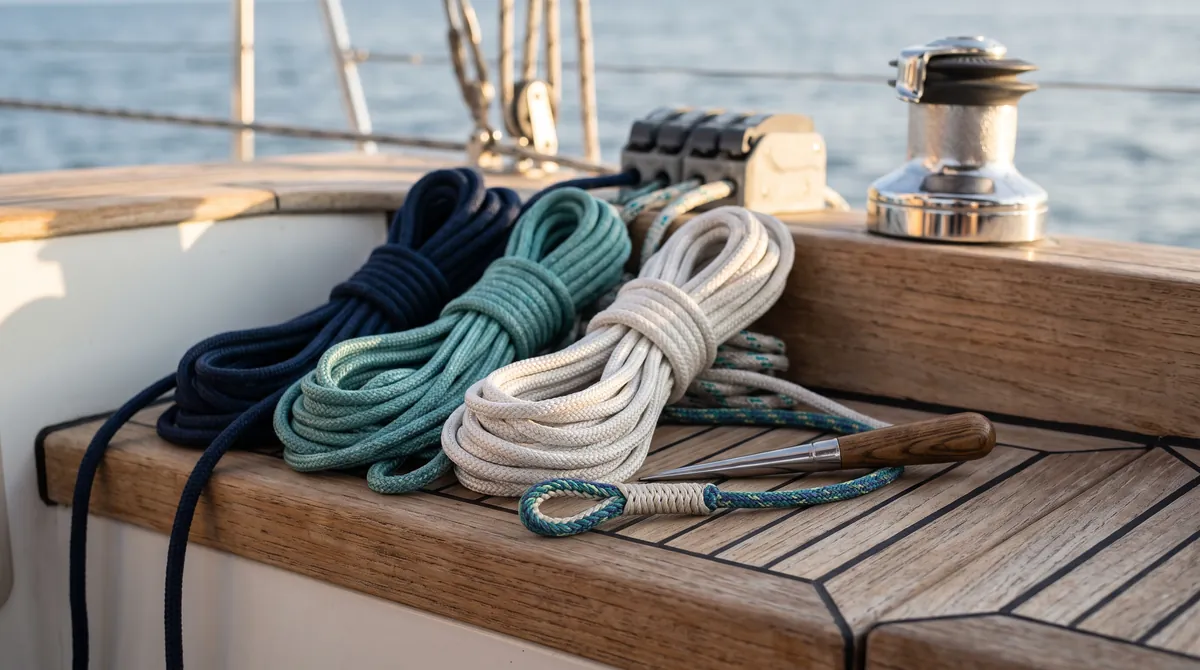
A splice keeps more of a rope’s strength than most knots, sits neatly and does not shake loose. Eye splices for halyard shackles, sheet ends and soft shackles are now common on cruising yachts as well as racing ones. Soft shackles, loops of HMPE closed with a locking knot, replace metal shackles in many places: they are light, quiet and gentle on gelcoat and hands, and there is no pin to drop over the side.
A splice keeps more of a rope’s strength than most knots, sits neatly and does not shake loose.
Typical upgrades when lines are due for replacement include:
- Lighter, lower stretch halyards with HMPE cores, which hold sail shape and reduce weight aloft.
- Spliced terminations in place of knots and some metal shackles.
- New or upgraded clutches that grip the chosen covers securely.
- Reefing lines led and sized so they run freely under load.
Size every rope for its load and for the fittings it runs through. A line that is too thin may be strong enough on paper but will slip in clutches and be hard to hold; one that is too thick will jam in sheaves and stiffen the whole system. The maker’s sizes for blocks, clutches and winches are the starting point, and a rigger can help balance strength, grip and handling.
Small marks, big difference
Mark halyards at their working positions, such as fully hoisted and at each reef, with a short whipping or a few stitches of coloured thread. Marks make sail handling faster and safer, especially at night or when sailing short handed, and they also reveal when a halyard has stretched or a sail has changed shape. Note what each mark means in the boat’s log, so the next crew understands them too.
Lay-up and spring
When the boat is laid up for the winter, many owners pull the halyards out of the mast and leave thin messenger lines in their place. The good rope then spends the winter clean, dry and out of the sun instead of slatting against the mast, and it can be washed, inspected and stored properly. Sheets and control lines come off too, so they do not sit wet in clutches and blocks for months.
Spring is the right time for a full survey of the running rigging. With the sails still off, every halyard can be pulled through, every sheet run through your hands and every block checked for a free-turning sheave and a sound shackle.
Questions and answers
How long do sheets and halyards last?
There is no fixed age. It depends on use, sun and how well the lines are looked after. Replace a rope when the cover is worn through, the core is damaged, it has glazed or it no longer grips properly in clutches and on winches.
Is HMPE worth it for a cruising yacht?
For halyards it often is, because low stretch keeps the sail shape steady as the wind rises. For sheets and control lines, a good polyester double braid is often perfectly adequate and kinder to handle.
How should I wash my ropes?
Many owners soak lines in a bucket of fresh water with a little mild soap, then rinse and dry them thoroughly before storing them loosely coiled. Avoid harsh detergents and check the rope maker’s care advice first.
Why does my halyard slip in the clutch?
The cover may be too slippery, too thin for the clutch or glazed, or the clutch itself may be worn. Check that rope diameter and cover suit the clutch, and inspect the clutch jaws for wear.
Our articles are general information written with care. Intervals and figures are guide values; the maker’s manual, your flag state, classification society and insurer take precedence, and safety critical work belongs with qualified professionals.