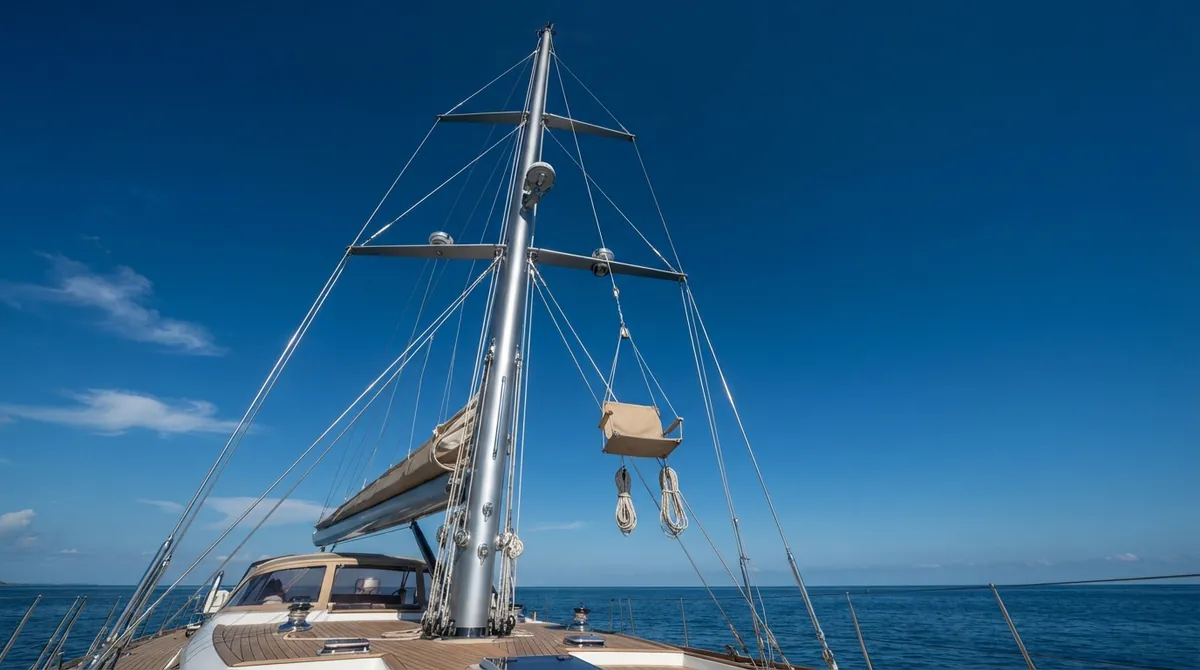

Standing rigging: inspection, age and when to replace it
Shrouds and stays rarely give much warning. Knowing what to look for aloft and on deck, and how age, material and the insurer’s view fit together, keeps the mast standing.
A rigger at the masthead on a quiet morning works slowly, with a magnifying glass, a rag and a torch, reading a story written in hairline cracks and faint rust stains that nobody on deck would ever see. Standing rigging is the part of a sailing yacht that does its job in silence, holding the mast upright through every gust and every wave, until the day a single fitting decides it has had enough. Most of those failures could have been seen coming.
What standing rigging does
Standing rigging is everything that holds the mast in place: the shrouds at the sides, the forestay and backstay fore and aft, and on many yachts intermediate shrouds, inner forestays and runners. Each piece ends in terminals, connects through toggles that let it articulate, and is anchored to the hull through chainplates. The load runs from the masthead down to the hull and keel, and the weakest link anywhere along that path sets the strength of the whole system.
Wire, rod or fibre
| Material | What it is | Strengths | Things to watch |
|---|---|---|---|
| 1x19 stainless wire | Nineteen stainless wires laid up as a single strand | Widely used, well understood, broken wires are visible | Hidden corrosion in swaged terminals, fatigue at bends |
| Rod rigging | Solid rods of a high strength stainless alloy with formed heads | Low stretch, long life when serviced, clean and slim | Fatigue at heads and bends, the maker’s service intervals |
| Synthetic fibre rigging | Fibre stays such as HMPE or PBO inside protective covers | Very light, less weight aloft | UV and chafe protection, creep, specific inspection rules |
Service and replacement rules for rod and synthetic rigging come from the maker and the rigger.
The choice of material is usually made at build or at a rerig, together with the rigger, and it shapes the inspection routine. Wire tends to announce trouble through broken wires and rust; rod and fibre are less forthcoming and follow their own service schedules.
Reading the signs
A yearly visual check, aloft and on deck, is the foundation. It should be done by someone who knows what to look for, with safe access and proper equipment, and it should cover every fitting from the masthead tangs down to the chainplates. Typical warning signs include:
- Broken strands, especially where wire enters a terminal or bends over a spreader.
- Rust staining or weeping at swaged terminals, which can point to corrosion inside.
- Hairline cracks in swaged terminals, often running along their length.
- Bent or stiff toggles that no longer let the fitting articulate.
- Wear and chafe at spreader tips, and spreaders that have lost their correct angle.
- Corrosion where chainplates pass through the deck, and leaks around them.
Some faults cannot be seen with the eye alone. At a proper rigging check, fittings are often tested with dye penetrant, which draws a bright line into any surface crack. It is a simple, well established method and worth asking for, particularly on older terminals. And never ignore a single broken strand: it is the clearest warning wire rigging will ever give you.
Never ignore a single broken strand: it is the clearest warning wire rigging will ever give you.
The hidden enemy at deck level
Chainplates deserve special attention. Where a stainless chainplate passes through the deck, it often sits in a narrow gap of trapped salt water that is starved of oxygen, exactly the condition in which stainless steel loses its protective surface layer. This crevice corrosion can eat into the plate unseen, below a perfectly polished surface. A leak at a chainplate is therefore not just a wet locker; it is a sign that the plate itself needs inspecting. Rebedding stops the water, but on an older boat the plate may need to come out for a proper look.
Age, insurers and the ten year question
Stainless wire rigging is often replaced after about ten years, even when it looks sound, because fatigue and internal corrosion do not always show on the surface. Many insurers ask for the age of the rigging and may limit cover for older wire, so keep the rigger’s report or invoice that dates it. Hard sailing, offshore miles and warm, salty climates can shorten that span, while a boat that has spent most of its life in a marina is still usually judged by age.
Rod and synthetic rigging have their own service rules from the maker, which may include re-heading rods or replacing fibre stays at set intervals. Follow them, keep the records, and when you buy a used yacht, ask for proof of the rigging’s age rather than a guess.
Winter: the mast comes down
Unstepping the mast over winter is the best opportunity for a thorough inspection. With the mast on trestles, every tang, pin, sheave and spreader root can be examined at eye level, the wiring for lights and instruments checked, and the mast step and its drainage cleaned and inspected for corrosion. It is also the right time to replace wire, because the rigger can measure and fit new stays on the ground rather than aloft.
If the mast stays up, a rigger can still inspect it aloft, but some things, such as sheaves, internal wiring and the mast step, are far easier to judge when it is down.
What a rerig involves
A full rerig usually means new wire or rod with new terminals throughout, and it is wise to look at the parts around them at the same time: toggles, clevis pins and split pins, and often the tangs and chainplates, which may be as old as the wire. Once the new rigging is in, the mast is tuned, checked again after the first sails in a good breeze, and retuned as the new wire beds in. Keep the rigger’s report with the boat’s papers: it is the record an insurer or buyer will ask to see.
If you are buying a used yacht, make the rigging part of the pre-purchase survey rather than an afterthought. Ask for the date of the last rerig and the invoices or reports that prove it, look below deck at the chainplates for rust streaks and water stains, and check whether the mast has been unstepped and inspected in recent years. A boat with a well documented rig is easier to insure and easier to sell again, and it tells you something about how the previous owner looked after everything else.
Questions and answers
How often should standing rigging be inspected?
A visual check aloft and on deck at least once a year is a sensible minimum, with a more detailed rigging check, including dye penetrant testing of fittings, at intervals your rigger recommends. After a hard passage or a knockdown, inspect again.
Does stainless wire rigging really need replacing after ten years?
About ten years is a common guide for stainless wire, and many insurers ask for its age. Use and climate matter: hard sailing and warm, salty conditions can shorten its life. Your rigger, the maker and your insurer set the actual limits.
What should I do if I find one broken strand?
Treat it as a sign that the wire is fatigued and should be replaced, not as something to watch. Avoid loading that stay hard and have a rigger look at it before you sail again.
Can I inspect the rigging myself?
An owner can see a lot from deck and with binoculars, and should look regularly. Going aloft needs proper equipment and safe practice, and a professional rigging check finds things an untrained eye misses.
Our articles are general information written with care. Intervals and figures are guide values; the maker’s manual, your flag state, classification society and insurer take precedence, and safety critical work belongs with qualified professionals.


