
Servicing winches: grease, pawls and a quiet click
A winch that turns freely and clicks crisply is a small pleasure and a real safety point. How an annual service works, and where owners most often go wrong.
Listen to a well serviced winch and you hear it before you see it: a crisp, even click as the pawls drop into their teeth, a smooth whirr as the drum spins free. A neglected one tells a different story, with a lazy, uneven click, a gritty feel through the handle and a drum that sticks on a cold morning. The difference is usually an afternoon’s work with a tray, a towel, a brush and a little patience.
Why winches need regular service
Winches work under high loads, in salt and spray, with the sun baking the grease inside them. Over a season that grease thickens, collects salt and dirt and eventually turns into a stiff paste that slows bearings and gums up pawls. Winches should be serviced at least once a year, and more often when they are used hard: on a raced yacht, in a hot climate or on a boat that sails through the winter. The pawls are the part that matters most, because they are what stops the drum turning back under load.
Inside, most yacht winches share the same anatomy: a drum turning on roller bearings around a central spindle, a train of gears that gives one or more speeds, and pawls with small springs that let the drum turn one way only. Two-speed and self-tailing winches add parts, not principles. Once you have seen one winch apart, the next one is far less daunting.
Reading a winch between services
A winch usually tells you when it needs attention. Watch and listen for:
- A gritty or uneven feel through the handle, or a drum that turns stiffly.
- A lazy or irregular click, or one pawl that has gone silent.
- A drum that sticks or hesitates in cold weather.
- White salt deposits or black, dirty grease at the base of the drum.
- Play or wobble when you rock the drum by hand.
- A self-tailer that no longer holds the line.
Prepare the workspace
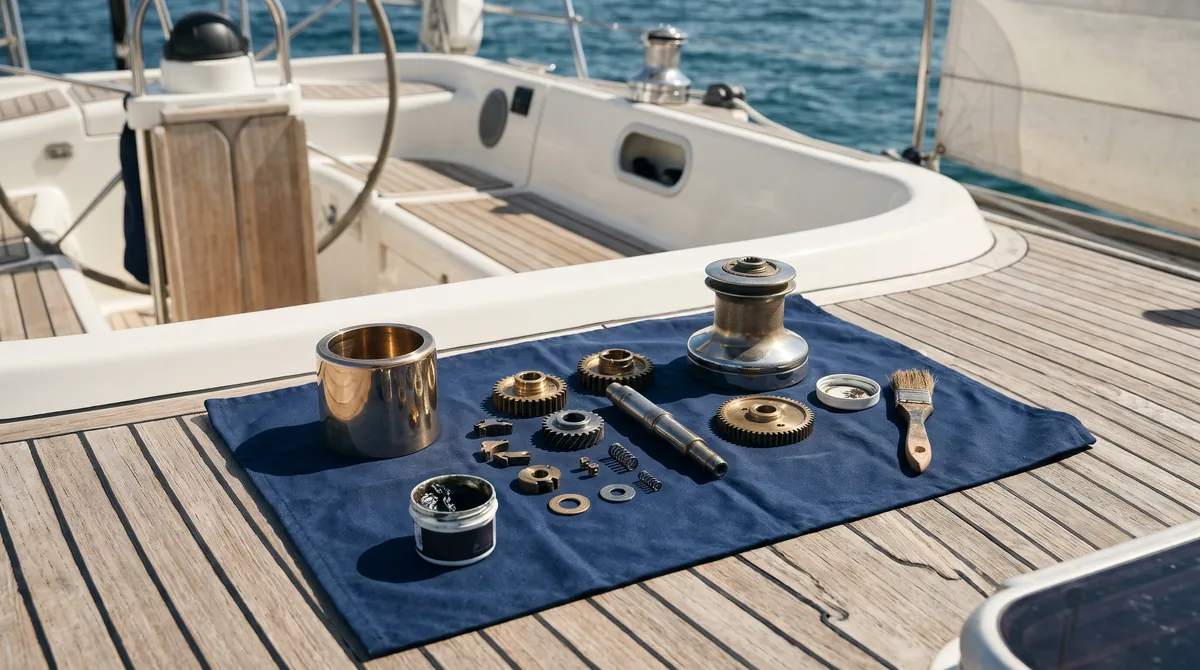
Most winches come apart in a similar way, but the details vary, so follow the maker’s instructions and keep a copy of the exploded drawing to hand. Work over a towel or a tray with a rim, so that a dropped spring or pawl does not bounce across the cockpit and over the side. Lay every part out in the order it came off, on a clean cloth in a line from left to right, and take a photograph at each stage. Small parts vanish with surprising ease, and a winch reassembled from memory may not work as it should.
The service, step by step
- Remove the drum as described by the maker, usually after taking off the top cap or retaining ring.
- Lift out the bearings, gears and pawls in order, noting which way each part faces.
- Clean off old grease and dirt with a suitable degreaser and a brush, then dry every part.
- Inspect gears, bearings, pawls and pawl springs for wear, cracks, corrosion and chipped teeth.
- Replace the pawl springs as routine, together with any worn pawls, bearings or gears.
- Apply winch grease thinly to gears and bearings, and only a light oil to pawls and their springs.
- Reassemble in reverse order, then turn the winch by hand in each gear and listen to the pawls.
Do not skip the last step. Turn the drum slowly and check that each pawl clicks crisply and engages every time. If a pawl stays silent, it is probably stuck or fitted the wrong way round, and the winch is not safe to load until it has been put right.
Grease and oil: the classic mistake
The most common error is too much grease, and grease in the wrong place. Pawls must move freely and snap back under the force of their small springs. Packed in thick grease, especially in cold weather, they can stick open. A winch with stuck pawls can spin backwards under load without warning. That is why pawls and their springs get only a light oil, while gears and bearings get a thin film of winch grease. More is not better: excess grease attracts dirt and salt and makes the next service harder.
A winch with stuck pawls can spin backwards under load without warning.
Self-tailers and the parts that wear
Self-tailing winches have their own wear points. The jaws that grip the rope wear smooth with time, so lines begin to slip, and the stripper arm that lifts the rope out of the jaws wears at its edge and can start to chafe the line. Check both at every service and replace them when the grip fades or the stripper shows sharp edges. Rope diameter matters too: a line that is too thin for the jaws will never tail properly, however new they are.
Electric winches
Electric winches add a motor and gearbox below deck, and with them a second set of checks. The drum is serviced much like a manual winch, but the motor, gearbox and connections need attention as well: corrosion on terminals, damp in the motor housing and tired seals can all reduce power or cause failure. Before any work, the winch must be isolated from its power supply. Electrical faults, cabling and control circuits belong in the hands of a qualified marine electrician.
The motor often lives in a locker that also takes wet lines, fenders and spray from the deck above. Keep that space as dry and ventilated as you can, and look at the motor housing and its connections whenever you open the locker. Green or white deposits on terminals are an early sign that moisture is getting in.
Through the season
Plan the full service for lay-up or just before launching, when there is time to do it without rushing. During the season, rinse winches with fresh water after salty sails, especially if the boat is left for weeks, and give each drum a few turns by hand when you come aboard. Keep a small kit on board: spare pawls and pawl springs for each winch size, a tub of winch grease, a small bottle of light oil, a brush, rags and the exploded drawings. With that kit and a towel spread underneath, a sticking winch can be put right at anchor.
Questions and answers
How often should winches be serviced?
At least once a year for most cruising yachts, and more often for winches used hard, raced or sailed in hot, dusty or salty conditions. A winch that feels gritty or clicks unevenly should be serviced straight away.
Can I use ordinary grease on a winch?
Use a grease intended for winches, applied thinly to gears and bearings. General purpose greases can be too stiff or behave differently in salt water. Pawls and pawl springs should only get a light oil.
Why should pawls not be greased?
Grease can hold pawls open, especially in cold weather, so they fail to engage. A winch with stuck pawls can spin backwards under load. A light oil lets them move freely.
Can I service an electric winch myself?
The drum can usually be serviced like a manual winch once the power is isolated. Motors, gearboxes and electrical connections are better left to a qualified marine electrician.
Our articles are general information written with care. Intervals and figures are guide values; the maker’s manual, your flag state, classification society and insurer take precedence, and safety critical work belongs with qualified professionals.