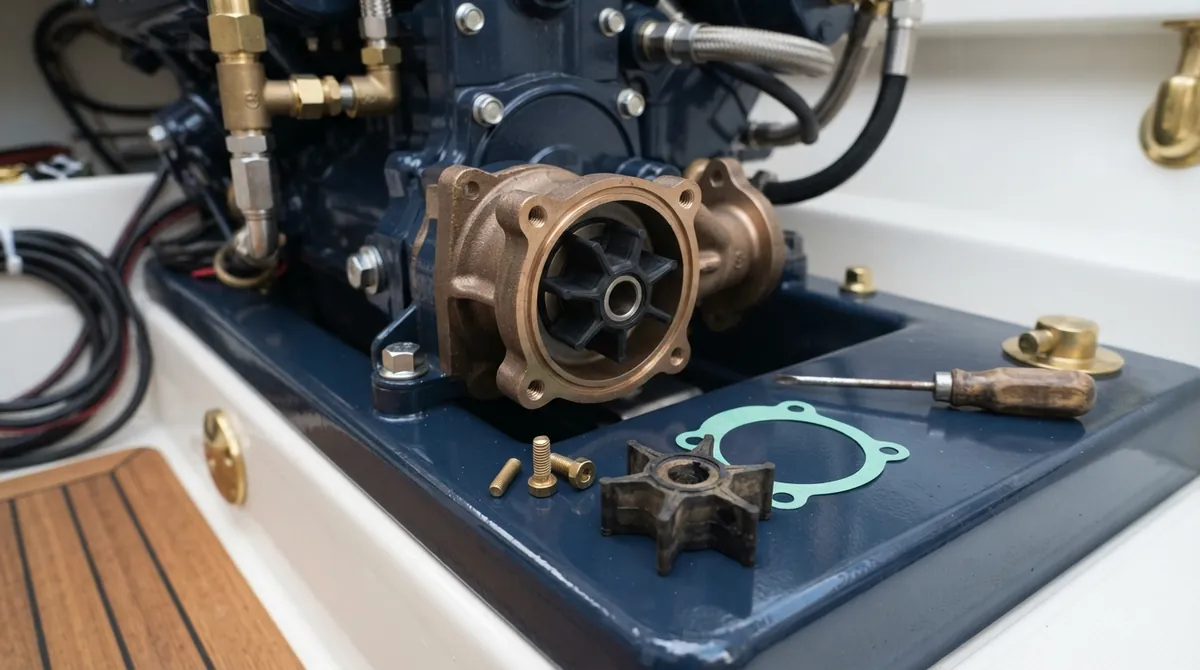

Cooling systems: following the seawater from seacock to exhaust
Most small marine diesels are cooled twice, by fresh coolant inside and by seawater outside. Here is the path the water takes, where it goes wrong and what to look for after an overheating.
Stand at the stern of a motoring yacht and you can read the engine’s health in the water. A steady, spitting stream from the exhaust outlet, mixed with puffs of grey, means seawater is flowing as it should. A thin dribble, or a sudden cloud of steam, means something upstream has gone wrong and the temperature alarm is only moments away. Cooling problems are among the most common engine troubles on small yachts, and most of them begin with something small: a worn impeller, a strainer full of weed, a seacock left closed after the winter.
Two circuits, one heat exchanger
Most small marine diesels are fresh water cooled. Inside the engine, a closed circuit of coolant, a mix of fresh water, antifreeze and corrosion inhibitor, circulates through block and cylinder head, driven by a circulation pump and governed by a thermostat. The coolant carries heat to the heat exchanger, a bundle of tubes in a casing, where seawater flowing through the tubes takes it away. The seawater is then injected into the exhaust at the mixing elbow, cooling the hot gas and leaving the boat with it.
Some boats use keel cooling instead: the coolant runs through pipes or channels on the outside of the hull and the sea cools it directly, with no raw water pump at all. It brings its own care points, since the coolers must be kept free of fouling and protected against corrosion. For everyone else, following the raw water path in order gives a natural inspection route.
- Seacock. Opens and closes smoothly, with sound hose clamps and no weeping.
- Raw water strainer. Clean basket, clear lid and a seal that does not draw air.
- Impeller pump. Flexible rubber impeller, cover plate and gasket, no drip from the shaft seal.
- Heat exchanger. Tubes free of scale, weed and broken impeller vanes.
- Anti-siphon valve. Where fitted, clean and working.
- Exhaust mixing elbow. No carbon choke, no corrosion, no weeping joints.
The impeller: soft, simple and never to run dry
The raw water pump on most small diesels uses a flexible rubber impeller, a little wheel of vanes that bend as they sweep through an off-centre housing and push the water along. Rubber is the right material for the job, but it has two enemies: age and dryness. Over time the vanes take a set and crack at their roots. Run dry, even briefly, they heat up and tear within seconds, because the water itself is what cools and lubricates them.
That is why many owners change the impeller every year, whatever it looks like, and carry spares aboard along with a cover gasket and the right tool to pull it. When you fit a new one, a smear of the lubricant the manual recommends helps it through its first turns, and all the vanes should lie in the same direction. Never start the engine with the seacock closed.
Rubber is the right material for the job, but it has two enemies: age and dryness.
Heat exchanger, coolant and thermostat
Over the seasons, the seawater side of the heat exchanger collects scale, silt and the odd piece of weed or shell that slipped past the strainer. Each layer reduces its ability to shed heat, which is why an engine that ran cool for years begins to run warm in a hot summer. Cleaning the tube bundle, a job a yard often does every few seasons, restores the margin. Where small anodes are fitted inside the exchanger, they are checked at the same time.
On the fresh water side, coolant is mixed to the strength the manual gives and changed at its interval, because the corrosion inhibitor wears out even while the antifreeze still tests well. The thermostat lets the engine warm quickly and then holds it at working temperature, often somewhere around 70 to 90 °C depending on the engine. One that sticks closed causes overheating; one that sticks open leaves the engine running cold, sooty and inefficient.
The anti-siphon valve and why waterline height matters
Where the exhaust injection point sits near or below the waterline, seawater can siphon back through the raw water circuit after the engine stops, slowly filling the exhaust and, in the worst case, the cylinders. An anti-siphon valve, fitted at the top of a loop of hose well above the waterline, breaks the siphon by letting air in. Its small valve can stick with salt crystals, so it needs a rinse and a check at every service. If you are unsure whether your installation needs one, ask an engineer to judge the height of the elbow with the boat loaded and heeled as she sails.
Warning signs and what they usually mean
| What you notice | Common causes | First check |
|---|---|---|
| Little or no water at the exhaust | Closed seacock, blocked strainer, worn or failed impeller | Seacock, strainer, then impeller |
| Temperature alarm under load | Scaled heat exchanger, tired impeller, slipping belt, fouled intake | Exhaust water flow and belt tension |
| Steam from the exhaust | Raw water flow lost, exhaust running hot | Stop the engine and check the raw water side |
| Coolant level falling | Leaking hose, pump seal or heat exchanger | Hoses and clamps, then a pressure test by a yard |
| Engine slow to warm up | Thermostat stuck open | Thermostat at the next service |
General guide only. The maker’s manual gives the correct temperatures, intervals and procedures.
After an overheating
If the alarm sounds, reduce revolutions and stop the engine as soon as it is safe to do so, then let it cool before opening anything on the fresh water side, because hot coolant under pressure can scald. Then follow the water path from the seacock onwards. Very often the culprit is an impeller with missing vanes, and those fragments do not disappear: they travel downstream and lodge in the inlet of the heat exchanger, where they block tubes and cause the next overheating. Open the end cap, find every piece and count them against the old impeller.
A serious overheating can also harm the rubber exhaust hose, which relies on the cooling water, as well as gaskets and the water lock. Ask an engineer to check them before you trust the engine on a passage. A small cooling kit aboard turns most of these problems into half an hour’s work at anchor:
- spare impellers and cover gaskets
- the tool for pulling the impeller
- a spare thermostat with its gasket
- a length of the correct hose and spare stainless clamps
- coolant premixed to the right strength
Questions and answers
How often should I change the raw water impeller?
Many owners change it every year as a precaution, whatever its condition, and the manual gives the maker’s interval. An impeller that has run dry, even briefly, should be changed straight away. Always carry spares.
Why is my engine running warmer than it used to?
A slowly scaling heat exchanger, a worn impeller or a partly blocked strainer are common reasons. Belt tension and fouling around the water intake also play a part. A yard can clean the heat exchanger and check the flow.
Does my boat need an anti-siphon valve?
It depends on how high the exhaust injection point sits above the waterline when the boat is loaded and heeled. Where it is near or below the waterline, a valve is usually fitted. An engineer can measure and advise.
What is keel cooling?
On some boats the engine coolant runs through coolers on the outside of the hull, so the sea cools it without a raw water pump. The coolers need protection from fouling and corrosion and regular checks of their own.
Our articles are general information written with care. Intervals and figures are guide values; the maker’s manual, your flag state, classification society and insurer take precedence, and safety critical work belongs with qualified professionals.