
Diesel bug and clean fuel: keeping tanks and filters clear
Microbial growth in a diesel tank blocks filters at the worst possible moment. Here is where it comes from, how to keep it out and what to do when the filter bowl turns dark.
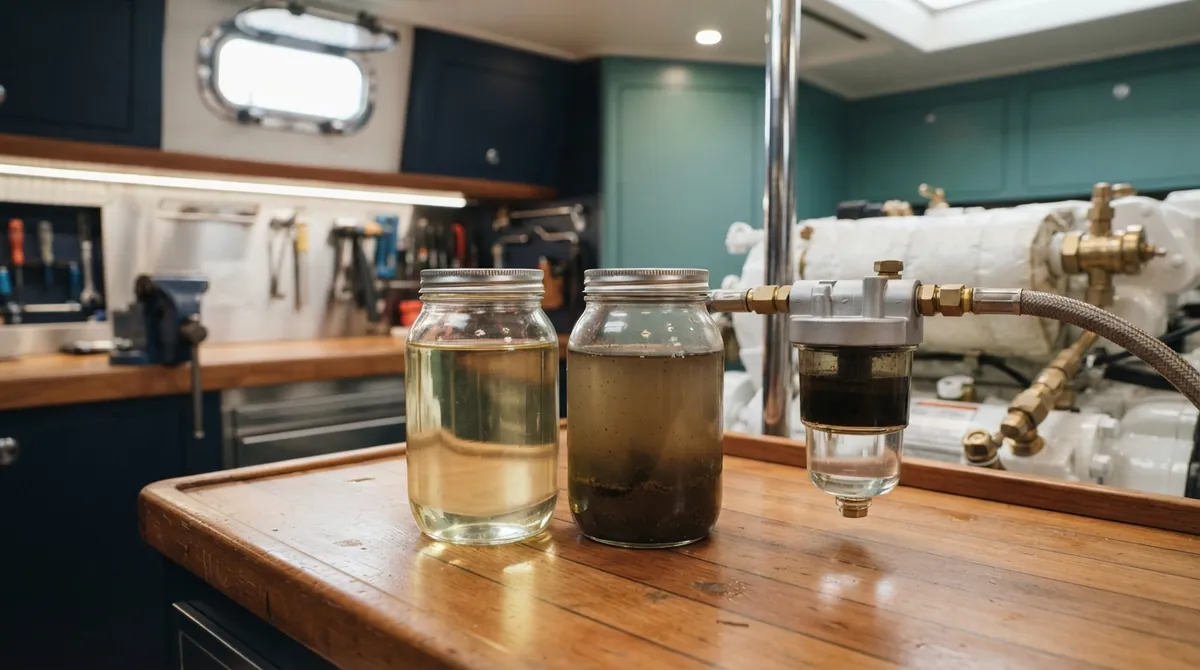
It usually happens in a seaway. The boat has been pitching for an hour, the tank has been shaken like a bottle of dressing, and the engine begins to hunt, falter and lose power until it stops. Down below, the clear bowl of the fuel pre-filter is no longer clear: it is dark, with a layer of something brown and slimy at the bottom. The fuel was fine in the harbour. What changed is that months of quiet growth on the tank floor were stirred up and sent straight to the filters.
What diesel bug actually is
Diesel bug is the common name for microbial contamination of fuel: bacteria and fungi that live at the boundary between fuel and water at the bottom of the tank. They feed on the fuel, multiply in the water and form a mat of slime and sludge, along with acidic by-products that can attack tank surfaces. Without water, diesel bug cannot thrive, and that is the key to almost all prevention.
The slime itself is the problem for the engine. It does not burn; it clogs. Strands and clumps reach the pre-filter first, then the engine filter, and as both block, the engine is starved of fuel. Because the mat lies quietly on the tank floor, a boat can run for weeks without trouble and then fail as soon as rough water mixes it up.
Without water, diesel bug cannot thrive, and that is the key to almost all prevention.
Where the water comes from
- Condensation. Air in a partly empty tank breathes in and out with the temperature and leaves droplets on the cold walls.
- Deck fillers. A worn seal on the filler cap lets rain and spray in, and a little every week adds up.
- The fuel itself. Fuel can arrive with water already in it, especially from poorly kept storage tanks.
- Vent lines. A vent placed low or facing the wrong way can take water aboard in a seaway.
Then there is the fuel’s own make-up. Road diesel in the European Union may contain up to 7 per cent biodiesel, known as FAME. Biodiesel can absorb more water than conventional diesel and tends to age faster in storage, which suits a car that fills up every week better than a yacht whose tank may sit for months. Where you have a choice, ask at the fuel berth what the fuel contains, and treat long storage with extra care.
Prevention through the seasons
Most of the work against diesel bug is unglamorous and regular. Over winter, the tank is commonly kept full to leave as little air as possible for condensation. During the season, water is drained from the pre-filter bowl whenever it appears, which also shows how much is reaching the filter. Biocide additives kill microbial growth and are used strictly according to their instructions, as a preventive dose or a shock treatment. They do not remove the dead slime, which still has to come out through the filters or a tank cleaning.
| When | What to do | Why |
|---|---|---|
| Laying up | Fill the tank, check the filler seal, dose biocide if you use it | Less air, less condensation, less water at the bottom |
| Spring commissioning | Drain the pre-filter bowl, inspect the element, renew filters | Shows what grew over winter before you leave the berth |
| Every refuelling | Use clean sources, check the filler cap seal | Keeps water out at the source |
| During the season | Drain water from the bowl as soon as it appears | Water in the bowl means water in the tank |
| Every few seasons | Inspect the tank through its hatch and clean it if needed | Removes sludge that filters cannot |
Guide values only. Follow the engine maker’s manual and the instructions for any additive.
Tanks, inspection hatches and fuel polishing
A tank with an inspection hatch can be opened, pumped out at the bottom and wiped clean, which removes the sludge that no additive will shift. Many older tanks have no hatch, and fitting one is a job for a yard, because cutting into a fuel tank carries real fire and vapour risks. Steel and aluminium tanks deserve a look for corrosion while they are open.
Larger yachts often carry a fuel polishing system, a separate pump and filter set that draws fuel from the bottom of the tank, passes it through fine filtration and returns it, removing water and particles independently of the engine. On smaller boats, a yard can polish the fuel with a mobile unit during a refit, often together with a tank cleaning.
Look at the fuel hoses at the same time. In the engine room, fuel lines should be fire resistant marine fuel hose, marked as such, with sound clamps. Hose that has hardened or weeps at its fittings is a fire risk as well as a source of air leaks, and renewing it properly is work for a professional.
Symptoms worth acting on
Diesel bug rarely announces itself gently, but there are early signs if you look:
- the engine losing power under load, then recovering at lower revolutions
- dark or cloudy fuel in the pre-filter bowl
- slime, brown mats or a jelly-like layer on the filter element
- filters that block much sooner than they used to
- a sour or unusual smell from the tank or filter
If you see these, renew both filters, drain the bowl and think about the tank rather than only the filter. A filter change buys time; cleaning the tank solves the problem.
Bleeding the engine: know it before you need it
Changing a filter at sea is only half the job, because air in the fuel system stops most diesels as surely as slime does. Every owner should know where the bleed points and the lift pump lever are on their engine, and the order the manual gives for bleeding. Practise it once at the berth, in calm water and good light, with rags and a small container ready. Carry at least two sets of filter elements aboard and keep them in a dry, labelled bag that you can reach without emptying a locker.
Clean fuel is not one heroic job. It is a habit of full tanks over winter, drained bowls in summer and a tank that is opened and looked at every few years. The reward is an engine that keeps running when the sea gets rough, which is exactly when you need it most.
Questions and answers
Does a biocide get rid of diesel bug?
A biocide kills the microbes, but the dead slime stays in the tank until it is filtered out or the tank is cleaned. That is why filters often block soon after a treatment. Follow the dosage on the product.
Should I keep the tank full over winter?
A full tank leaves less air space for condensation, so less water forms on the tank walls. Many owners and yards fill up before laying up for this reason. Check the filler cap seal at the same time.
How do I know if my tank needs cleaning?
Repeated dark or slimy filter bowls, filters that clog quickly and sludge on the elements are strong signs. A yard can open the tank through an inspection hatch and look. If there is no hatch, ask whether one can be fitted safely.
Our articles are general information written with care. Intervals and figures are guide values; the maker’s manual, your flag state, classification society and insurer take precedence, and safety critical work belongs with qualified professionals.