
Generators and watermakers: the comfort systems that need care
Power at anchor and fresh water made from the sea feel like quiet luxuries, until a membrane fouls or a generator soots up. Here is how to keep both working for many seasons.
At anchor in a quiet bay, the comfort systems are the ones you hear least and appreciate most. A muffled hum behind a sound shield, a faint whine from the watermaker, and somewhere a tank slowly filling with fresh water made from the sea around you. On larger yachts these machines run for hours every day; on smaller ones they are often the first equipment to suffer from neglect, because they are tucked away, used irregularly and simply expected to work. Both repay a little understanding.
The generator is a small diesel with a job
A diesel generator is serviced much like a propulsion engine: oil and oil filter, fuel filters, air filter, raw water impeller, drive belts, coolant and internal anodes, all at the intervals in the manual, usually counted in running hours. Because a generator can run far more hours than the main engine during a summer at anchor, those intervals come round surprisingly quickly, and its hour counter deserves a regular look. What really sets it apart, though, is how it is used. It runs at a fixed speed, and its load depends entirely on what is switched on aboard.
Light loads and wet stacking
A diesel likes to work, and a generator left running under a tiny load slowly fouls itself. With only a few lights and a fridge to supply, it never reaches the temperature and pressure it was designed for. Fuel does not burn completely, and unburnt fuel and soot collect in the exhaust, on the injectors and around the valves. Engineers call this wet stacking. Its signs are a black, oily residue at the exhaust outlet, more smoke and, over time, lost performance.
A diesel likes to work, and a generator left running under a tiny load slowly fouls itself.
The remedy is sensible load management. Group the heavy users, such as water heating, battery charging, cooking and the watermaker, into the hours when the generator runs, so that it works at a reasonable share of its rating. Many yachts now pair a generator with a larger battery bank and an inverter: the generator runs less often but properly loaded, charging the batteries, and the batteries supply quiet power for the rest of the day and night.
| Approach | How it works | Points to consider |
|---|---|---|
| Generator on demand | Runs whenever power is needed | Simple, but long spells at light load encourage wet stacking |
| Scheduled runs with grouped loads | Heavy users run together while the generator is on | Better loading, needs some discipline aboard |
| Battery bank and inverter | Generator charges batteries; the inverter supplies power in between | Quieter nights and fewer hours; batteries need space, ventilation and correct charging |
Sound shields, exhaust and access
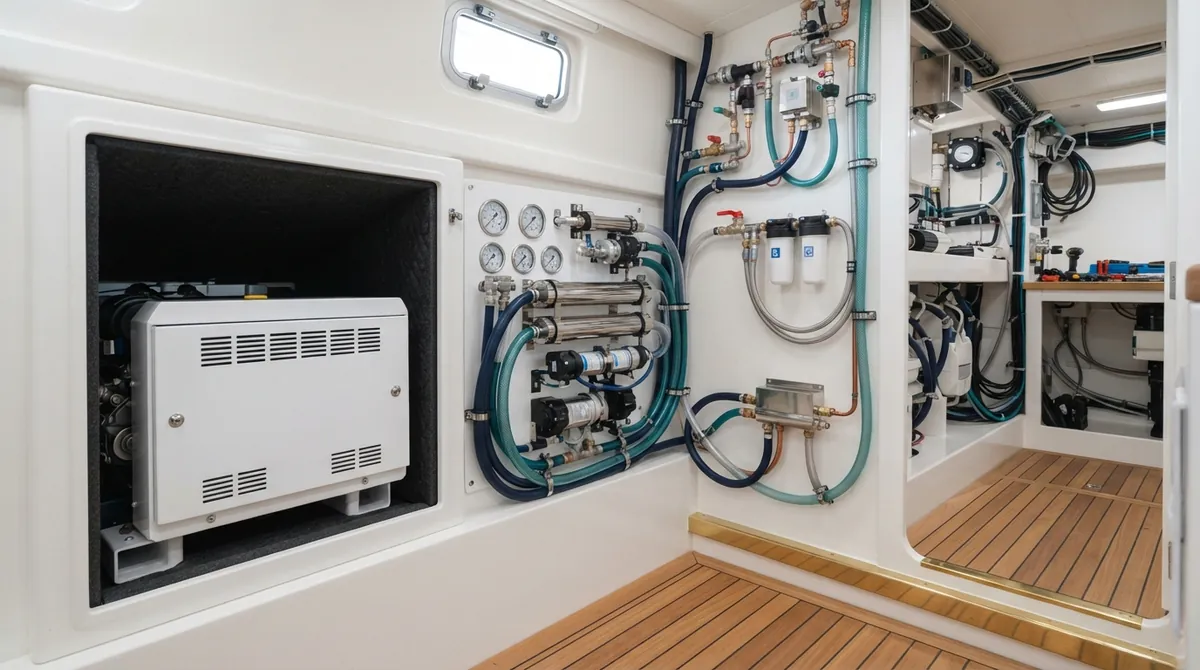
Most yacht generators sit inside a sound shield, an insulated box that keeps noise and vibration out of the cabins. It also hides leaks and makes service awkward, so it should be opened regularly and the inside inspected for traces of oil or coolant, a loose clamp or a damp patch below the raw water pump. The exhaust, usually wet and often with its own water lock and silencer, needs the same attention as the main engine’s, mixing elbow included. A good installation gives the generator enough ventilation for combustion air and cooling, and enough room to change a filter without dismantling the boat around it.
How a watermaker turns seawater into drinking water
A watermaker works by reverse osmosis. A high pressure pump forces seawater against a semi-permeable membrane at a pressure far above anything else in the boat’s plumbing, and mainly water molecules pass through, leaving most of the salt behind in a stream of brine that returns to the sea. Before the seawater reaches the membranes, it passes through a sequence of pre-filters that remove sand, plankton and fine particles, because the membranes are delicate and they are the heart of the system.
The quality of the product water is measured as total dissolved solids, usually by a small salinity probe in the outlet line. Many systems divert water to waste until the reading falls below the limit in the manual, and only then send it to the tank. Capacity is given in litres per hour, and the energy needed, whether from the generator, an engine driven pump or the batteries, is part of the planning: a large watermaker running from batteries asks a lot of the electrical system.
Living with membranes
Membranes reward routine and punish neglect. A few habits keep them healthy:
- Change pre-filters at the interval in the manual or when the pressure drop across them rises.
- Flush with fresh water after every use, so that seawater does not sit in the membranes and grow a biological film.
- Pickle the membranes with the preserving solution the maker specifies when the unit will be unused for longer, such as over winter.
- Check the product water reading every time and log it; a slow rise shows a tiring membrane.
- Never run it in polluted or oily water, because oil and chemicals can damage the membranes permanently.
The last point matters most. A watermaker is best used offshore or in clean anchorages. In a marina basin, near a fuel berth or close to a river mouth after rain, the feed water can carry oil, fuel or chemicals that no pre-filter will stop. Fill the tanks from the shore supply in harbour, and make water where the sea is clean.
Installation and access for both
Both systems are only as good as their installation. A generator needs proper ventilation, a sound exhaust and room to service it; a watermaker needs its own seacock and strainer, a feed taken where the water is cleanest and space to change filters and reach the membranes. When buying a used yacht, ask for the service records of both, the age of the membranes and when the generator last had its valves and mixing elbow checked. On larger yachts an engineer looks after them; on smaller boats, an owner who understands them will get many more years of quiet comfort from both.
Questions and answers
What is wet stacking?
It is the build-up of soot and unburnt fuel in a diesel that runs for long periods at very light load. It shows as a black, oily residue at the exhaust and gradually lost performance. Sensible loading prevents it.
When should a watermaker be pickled?
Whenever it will stand unused for longer than the manual allows between flushes, for example over winter or between trips. Pickling uses a preserving solution specified by the maker. Fresh water flushing covers shorter breaks.
Can I make water in the marina?
It is best avoided. Harbour water often contains oil, fuel or chemicals that can damage membranes permanently. Use the shore supply in harbour and run the watermaker in clean water.
Further reading in our network
- LaxaryLuxury lifestyle
Luxury lifestyle stories on design, travel and the art of living well, ashore and afloat.
Our articles are general information written with care. Intervals and figures are guide values; the maker’s manual, your flag state, classification society and insurer take precedence, and safety critical work belongs with qualified professionals.