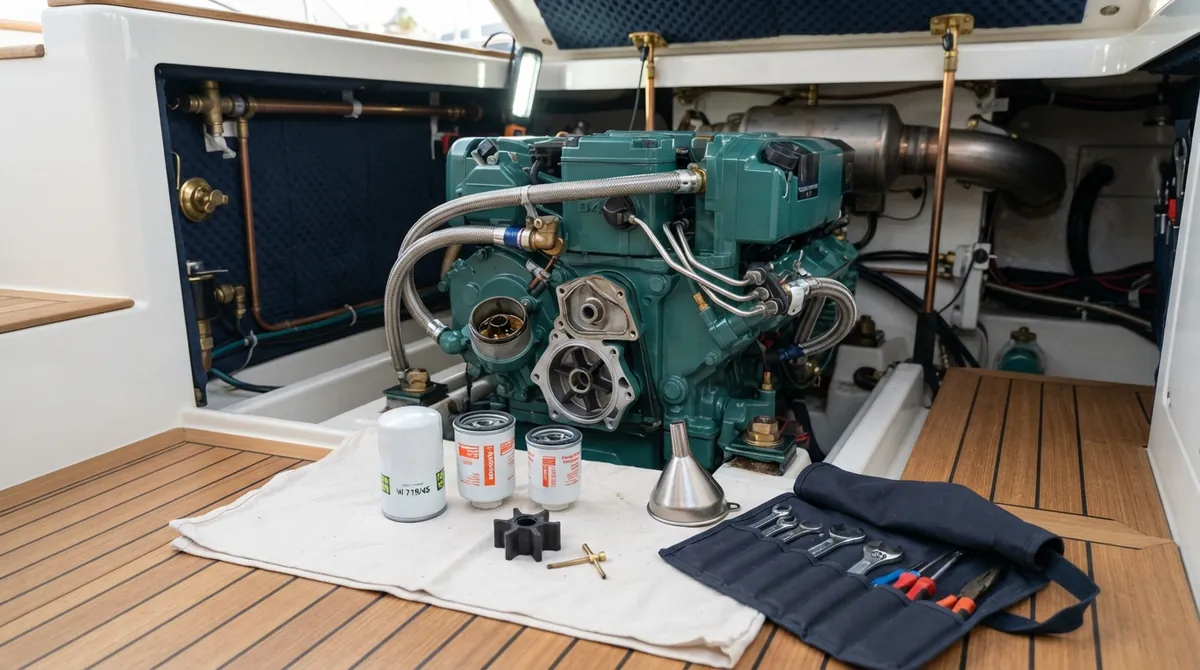

The yearly diesel service: an order of work that makes sense
A small marine diesel asks for little, but it asks every year. Here is the annual service in a sensible order, what each step tells you and why the logbook matters as much as the spanners.
The engine room hatch comes up and the smell tells you a little before the torch does: warm oil, a hint of diesel, salt drying on a hose clamp. A small marine diesel is a modest, patient machine. It will start on a cold April morning after months of silence and run for days without complaint, but only if someone has given it honest attention every year. The annual service is that attention, stretched over a day, and the order in which you do it matters almost as much as the work itself.
Begin with the logbook, not the spanner
Before a single drain plug is touched, open the engine log. Note the running hours on the hour counter, the date of the last oil change and anything the crew wrote down during the season: a slow start, a puff of smoke, a belt that squealed on a damp morning. Oil changes are usually due every 100 to 250 running hours, depending on the maker, and at least once a year even if the boat barely left her berth, because oil ages with time, moisture and combustion acids as well as with use. The manual gives the figure for your engine, and it always takes precedence over habit or harbour wisdom.
Then run the engine. Oil drains far better warm, carrying suspended dirt with it instead of leaving it on the floor of the sump, and a running engine lets you look and listen before you start taking things apart.
A sensible order for the day
Every yard has its own rhythm, but most experienced engineers follow a similar sequence. It moves from the jobs that want a warm engine to the jobs that want a cold one, and it leaves the bleeding and the test run until the end, when every filter and hose is back in place.
- Warm up and look. Run the engine for a while, check for leaks, smoke and unusual sounds, then stop it.
- Oil and oil filter. Pump or drain the warm oil, renew the filter and refill to the mark with the grade in the manual.
- Gearbox oil. Check level and condition, and change it at the stated interval.
- Fuel filters. Renew the water-separating pre-filter element and the engine filter, then bleed the system.
- Air filter. Clean or renew it; a choked intake shows up as smoke and lost power.
- Raw water side. Close the seacock, renew the impeller, clean the strainer and inspect the heat exchanger.
- Coolant and belt. Check the antifreeze strength or change the coolant, then inspect the drive belt for condition and tension.
- Hoses, clamps, mounts and elbow. A slow, careful look with a torch and a small mirror.
- Test run. Open the seacock, start, check for leaks, water flow and temperature, then log everything.
Oil, filters and the art of not making a mess
Most small marine diesels are drained from above with a hand or electric pump through the dipstick tube, because the sump plug sits where no spanner reaches. Put absorbent pads under the oil filter before you loosen it and slip a plastic bag around it as it comes off: a single cup of old oil in the bilge will find its way into every limber hole. Smear a little fresh oil on the new filter’s seal, tighten it by hand as the filter instructs and refill slowly, checking the dipstick twice with a pause in between for the oil to settle.
Fuel filters follow. The pre-filter with its clear bowl is your early warning system: water and dark sludge in the bowl say more about the tank than any gauge. After the elements are renewed, the system has to be bled of air until fuel flows without bubbles. It is worth practising this at the berth, in good light and with the manual open, rather than learning it in a swell.
Belts, hoses, mounts and the mixing elbow
These are the parts that fail quietly. A drive belt that has glazed or cracked on its inner face, or that deflects much further than the manual allows when you press it midway between the pulleys, will one day slip under the load of a large alternator. Hoses should feel firm, not soft or swollen, and clamps should be stainless and free of rust stains. On important hoses below the waterline, two clamps are common practice.
Engine mounts carry the whole engine and absorb its vibration. Look for rubber that has sagged, cracked or soaked up oil, and for mounts that have settled unevenly, which can upset the alignment with the shaft. Then look hard at the exhaust mixing elbow, where hot exhaust gas meets injected seawater. It is one of the hardest worked parts on the engine: carbon builds up inside and corrosion works from both sides, often invisibly, until the passage chokes or the casting weeps. Many engineers remove and inspect it at set intervals rather than waiting for symptoms.
Inside the engine: anodes, heat exchanger and valves
Some engines carry small zinc anodes inside the heat exchanger or the cooling passages. Where they are fitted, they are checked and renewed at every service, because a wasted anode means the metal around it is next. The heat exchanger itself can be cleaned of scale and debris, which restores its ability to shed heat; a yard will often do this every few seasons, and always after an overheating. Valve clearances are a job for the interval in the manual, usually given in running hours, and for someone with feeler gauges and patience, because a valve set too tight can burn and one set too loose will tap and wear.
Reading the signs between services
A diesel tells you a lot if you know how to listen, and the clues are worth writing down the moment you notice them.
| Sign | Often points to | Worth asking |
|---|---|---|
| Black smoke under load | Too much fuel for the air: choked air filter, overloading, a fouled hull or propeller, injector trouble | When were the hull, propeller and injectors last checked? |
| Blue or grey smoke | Oil being burnt: worn rings or valve stem seals, or an overfilled sump | Has oil consumption changed between services? |
| White smoke that lingers | Water or coolant reaching the cylinders, or very cold running | Is the coolant level dropping? |
| Oil in the bilge | Leaking seals, a poorly seated filter or a loose fitting | Where exactly does the trail begin? |
| Rising temperature | Raw water flow, impeller, heat exchanger, thermostat or belt | Is there normal water flow at the exhaust? |
| New knocks or rattles | Mounts, valve clearances, loose ancillaries or something more serious | Did it begin after a particular job or event? |
General guide only. Persistent symptoms belong in the hands of a qualified marine engineer.
Oil analysis is another way of listening. A small sample, taken warm at each change and sent to a laboratory, shows metals from wear, traces of coolant or fuel in the oil and the condition of the oil itself. One result on its own says little. A series of them, season after season, shows a trend, and a sudden change in that trend is worth a conversation with an engineer before it becomes a repair.
What an owner can do and what belongs to the yard
An owner with clean hands, the manual and a free weekend can manage most of the routine list: oil, filters, impeller, belt and a careful look at hoses and mounts. Valve clearances, injector work, heat exchanger cleaning, removing the elbow and anything involving the fuel injection pump are usually better left to a qualified marine engineer.
Whoever does the work, write it down. The logbook is the engine’s memory, and a good one is worth more than any single repair. It should record at least:
- running hours and date for every job
- oil grade and quantity, and the filter types listed in the manual
- impeller changes and the condition of the old impeller
- smoke, noise, temperature or starting observations during the season
- oil analysis results, kept together so the trend is easy to see
The logbook is the engine’s memory, and a good one is worth more than any single repair.
Kept this way, the log turns a folder of receipts into a history. When the time comes to sell the boat, that history is often the first thing a careful buyer and their surveyor will ask to see.
Questions and answers
How often should a marine diesel have its oil changed?
Most makers ask for an oil change every 100 to 250 running hours, and at least once a year even if the engine has barely run. Oil ages with time, moisture and acids from combustion. The figure in your manual is the one that counts.
Why change the oil with the engine warm?
Warm oil flows more freely and carries suspended dirt out with it. Cold oil leaves more of that dirt behind in the sump. A short run before draining is enough.
Is oil analysis worth it on a small yacht engine?
It can be, especially on an older engine or before buying a used boat. A single result is a snapshot; a series over several seasons shows how wear develops. Sudden changes are a reason to involve an engineer.
Can I do the annual service myself?
Many owners handle oil, filters, impeller and belt with the manual at hand. Valve clearances, injectors, heat exchanger cleaning and elbow work are usually best left to a qualified marine engineer. Whoever does it, record it in the log.
Our articles are general information written with care. Intervals and figures are guide values; the maker’s manual, your flag state, classification society and insurer take precedence, and safety critical work belongs with qualified professionals.