
Shafts, seals and propellers: what to check when the boat is out
The short run from gearbox to propeller carries all of the engine’s work into the water. A haul-out is the only time to see it properly, so here is what to look for.
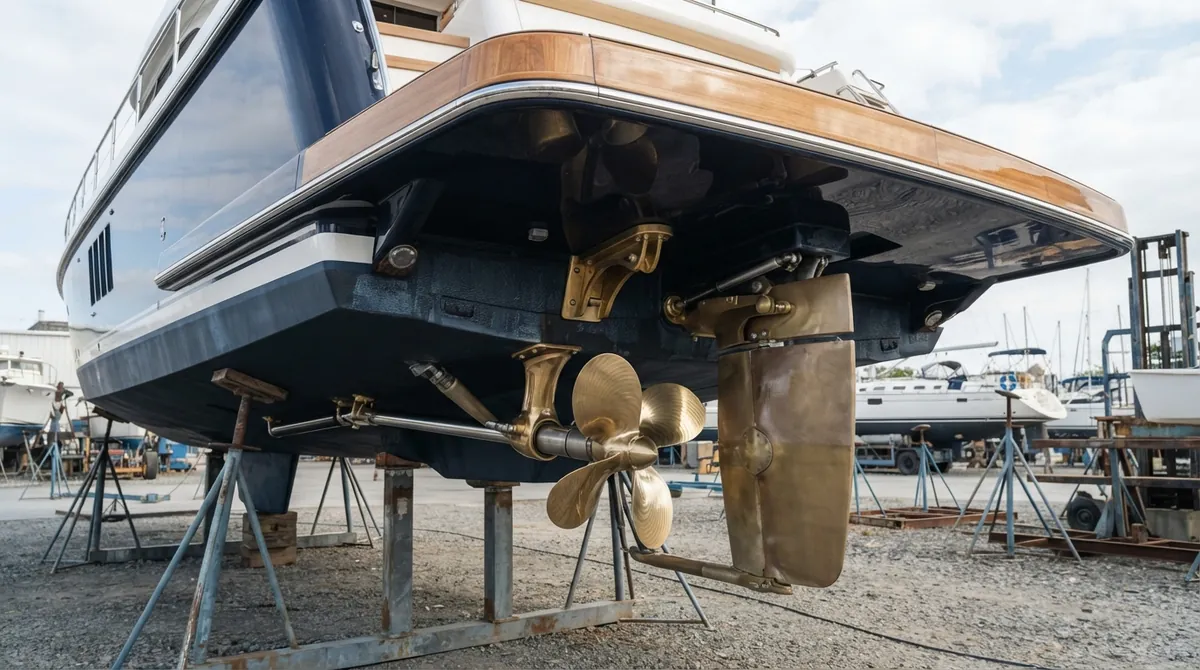
On the hard, with the hull on its cradle and the morning light falling under the stern, the shaft line looks almost decorative: a polished bar of stainless steel disappearing into the hull, a bronze propeller catching the sun, a bright new anode clamped in place. Afloat, you will not see it this clearly again until next year. That is why the hour you spend here with a torch, a rag and your hands on the shaft is one of the most valuable of the whole haul-out.
Three kinds of shaft seal
Where the shaft passes through the hull, a seal keeps the sea out while letting the shaft turn. There are three common designs, and each has its own way of telling you it needs attention.
| Seal type | How it works | What to check |
|---|---|---|
| Stuffing box | Rings of packing pressed around the shaft by a gland nut; a slight drip while turning cools and lubricates | Drip rate, hardened packing, a scored shaft, hose and clamps |
| Dripless face seal | A carbon or ceramic face pressed against a stainless collar by a rubber bellows | Cracks and age of the bellows, collar fixings, renewal at the maker’s interval |
| Lip seal | Flexible lips running directly on the shaft, lubricated by water | Wear, leaks and the condition of the shaft beneath the lips |
Intervals and settings follow the seal maker’s manual.
The traditional stuffing box should drip slightly when the shaft turns. That drip is not a fault: it cools and lubricates the packing. A stuffing box that never drips is not well adjusted; it is slowly destroying itself, hardening its packing and scoring the shaft. One that streams water needs adjusting or repacking. Never tighten a stuffing box until it is completely dry.
A stuffing box that never drips is not well adjusted; it is slowly destroying itself.
Dripless face seals stay clean and dry, but their rubber bellows age even when they look perfect. Seal makers give a renewal interval for the bellows and wearing parts, and it is wise to follow it rather than wait for a crack. Lip seals are simple and compact, but they depend on a smooth shaft surface beneath them.
Cutlass bearings and the feel of play
The cutlass bearing is a water lubricated rubber bearing, fluted along its length, that supports the shaft in the stern tube or in the P bracket further aft. Seawater flows through its grooves and keeps it cool. Over the years the rubber wears and the shaft begins to move in it.
To check it, take hold of the shaft close to the bearing and move it firmly up and down and side to side. A good bearing feels almost solid; a worn one lets the shaft knock. Any play you can clearly feel by hand is worth showing to the yard, which will compare it with the wear limit and decide whether the bearing should be pressed out and renewed. A worn bearing lets the shaft whip, which wears the seal and can damage the shaft itself.
Alignment belongs in the water
Engine and shaft must line up precisely at the coupling. Ashore, the hull rests on its keel and stands and takes a slightly different shape from the one it has when floating. That is why alignment is checked after launching, ideally once the boat has been afloat for a while and the hull has settled. The yard measures the gap between the coupling faces at several points around their circumference and adjusts the engine mounts until the faces sit parallel.
Misalignment is quiet but hard on parts: vibration at certain revolutions, a seal that never stops leaking, a cutlass bearing worn out within a season. If any of these appear after a launch, ask for the alignment to be checked before anything else is renewed.
Propellers: fixed, folding and feathering
Motor yachts and many sailing yachts use fixed propellers, while sailing yachts often choose folding or feathering designs that reduce drag under sail. Each type has its own inspection points.
- Fixed propellers. Look for bent or chipped blade edges, erosion and the fine pitting of cavitation, often on the back of the blades towards the tips.
- Folding propellers. Check that the blades open and close freely and evenly, and look for wear in the hinge pins and gear teeth.
- Feathering propellers. Check the blades for play in the hub, the condition of the gearing and the pitch setting, and grease them as the maker describes.
- All types. A sound nut and locking, a clean fit on the shaft taper and no loose blades.
Balancing, straightening bent blades and adjusting pitch are jobs for propeller specialists, who have the jigs and gauges to measure each blade. A propeller slightly out of balance or pitch may show itself only as vibration, or as an engine that no longer reaches its rated revolutions, so mention any such change when you send it away.
Anodes, bonding and rope cutters
Shaft and propeller sit in seawater beside other metals, so they need sacrificial protection. A shaft anode, clamped onto clean bare metal, or an anode on the propeller nut is commonly renewed when it is about half worn, and it is never painted. If an anode has wasted unusually fast, or has hardly worn at all, the bonding and the shore power connection deserve a check by a marine electrician, because either points to a problem that will eventually reach the bronze.
Rope cutters, fitted on the shaft just forward of the propeller, slice through stray lines and nets before they wrap and stall the engine. Check their blades for sharpness and damage and their fixings for tightness while the boat is out.
Back in the water: the first hour
Launch day has its own short list. Dripless face seals usually need burping after launching: the bellows is briefly compressed or the seal vented as the maker describes, to release trapped air so that water reaches the sealing faces. A seal running with an air pocket can overheat.
- Check the shaft seal for leaks before the slings come off.
- Burp the dripless seal, or check the stuffing box drip once the shaft turns.
- Run the engine in gear at the berth and feel for vibration.
- Book the alignment check once the hull has settled.
Questions and answers
How much should a stuffing box drip?
It should drip slightly while the shaft turns, often described as a few drops a minute, and little or not at all at rest. The seal or engine manual may give a figure. A box that never drips is too tight and will overheat.
When should a cutlass bearing be replaced?
When the shaft has noticeable play in it, or when the yard measures wear beyond the limit. A worn bearing lets the shaft move, which damages seals and causes vibration.
Why can’t alignment be done ashore?
The hull changes shape slightly when it floats. Alignment set on the hard can be out once the boat is in the water, so the final check is made afloat after the hull has settled.
What does burping a dripless seal mean?
After launching, air can be trapped in the seal. Burping releases it so seawater reaches the sealing faces and cools them. The seal maker’s manual describes how.
Our articles are general information written with care. Intervals and figures are guide values; the maker’s manual, your flag state, classification society and insurer take precedence, and safety critical work belongs with qualified professionals.