
Repowering a yacht: when a new engine is the honest answer
An old engine can be rebuilt more than once. Here is how to tell when a repower is the better choice, and why the engine itself is only one part of the project.
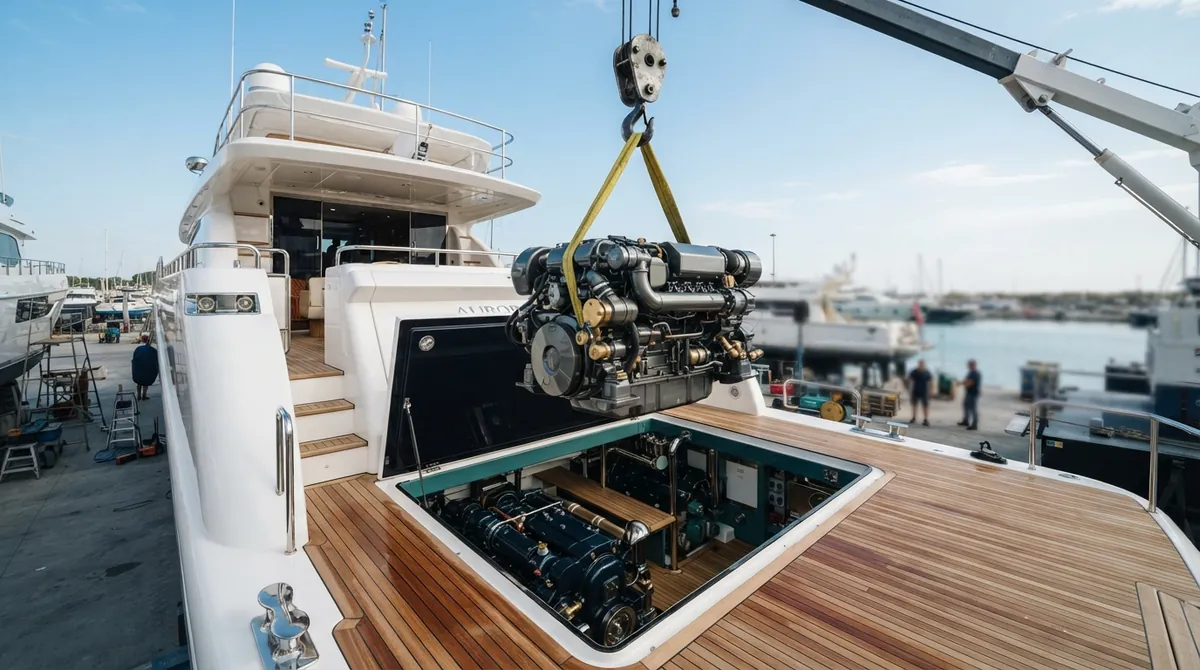
There is a particular silence in a boat shed when an engine comes out. The crane takes the weight, the old block swings clear of the companionway with a few centimetres to spare, and suddenly the engine room is an empty box of stained beds, cut hoses and decades of oily dust. For many owners that moment arrives after years of nursing a tired engine through one more season. The question that comes before it is harder: is a new engine really the answer, or would a rebuild do?
The reasons that usually add up
Rarely does a single fault decide it. More often several reasons arrive together and tip the balance.
- High hours and wear. Falling compression, rising oil consumption and smoke that no service cures.
- Parts no longer available. When gaskets, injection parts or heat exchangers become hard to find, every breakdown becomes a long wait.
- Unreliable starting. An engine you cannot trust off a lee shore is a safety question, not a comfort question.
- More power or less weight. A heavier boat after a refit, or the wish for a lighter installation.
- Lower emissions and noise. Modern engines are generally cleaner and quieter at a similar output.
Against these stands the rebuild. A sound old engine with good castings and available parts can be overhauled and run for many more years, and on a classic boat the original engine may be part of her character. A good engineer will tell you honestly which side of the line your engine is on, often after a compression test and a look through the oil analysis history.
The engine is only the beginning
Owners often think of a repower as buying an engine. Yards think of it differently, because almost everything that touches the old engine has to be checked, adapted or renewed for the new one. A repower is not the purchase of an engine but the rebuilding of everything the engine touches.
| Area | What has to be checked |
|---|---|
| Power and weight | Output suited to hull, displacement and use; weight and centre of gravity compared with the old engine |
| Beds and mounts | Strength, condition and dimensions of the beds; new flexible mounts matched to the engine |
| Alignment | Engine to shaft alignment, finally checked with the boat afloat |
| Gearbox and propeller | Reduction ratio, propeller diameter and pitch recalculated for the new power and revolutions |
| Exhaust | Diameter, routing, water lock and height of the injection point above the waterline |
| Fuel and cooling | Lines, filters, seacock and hose sizes suited to what the new engine needs |
| Controls and panel | Mechanical cables or electronic controls, instrument panel and wiring |
| Ventilation | Air supply and extraction for the engine room, sized for the new engine |
Beds, mounts and the line to the propeller
Engine beds are the foundation of the whole installation. On a fibreglass boat they are often laminated over timber or foam cores, and decades of oil and vibration can soften them. A new engine rarely has the same footprint as the old one, so beds are commonly cut, built up or remade. The chance to inspect them properly should never be missed while the engine room is empty.
The engine then has to line up precisely with the shaft. Alignment is set roughly ashore and checked again afloat, because the hull changes shape slightly once it floats in its own water. Misalignment shows up within a season as vibration, worn cutlass bearings and leaking shaft seals.
The propeller deserves the same care. A new engine with different power and maximum revolutions, behind a gearbox with a different ratio, will rarely suit the old propeller. Diameter and pitch, still given in inches in the trade as well as in millimetres, are recalculated by a specialist so that the engine reaches its rated revolutions at full throttle without labouring or over revving.
Exhaust, fuel, cooling and controls
The new engine may need an exhaust of a different diameter or a new water lock, and the height of the exhaust injection point relative to the waterline decides whether an anti-siphon valve is needed. Fuel lines, filters and return lines must suit its fuel system, and the raw water seacock and hoses must deliver the flow it asks for. Mechanical control cables may carry over, but many modern engines use electronic controls with their own panel and harness, which means new cable runs and a fresh look at the electrical system behind the panel.
A repower is not the purchase of an engine but the rebuilding of everything the engine touches.
Emissions, weight and trim
In the European Union, new engines installed in recreational craft must meet the exhaust and noise emission limits of the Recreational Craft Directive (2013/53/EU). Your engineer and the engine supplier will confirm which requirements apply to your installation and which documents come with the engine. Ask about this early, because it can narrow the choice.
Weight is the other quiet factor. A modern engine of similar power is often lighter than the iron block it replaces, which sounds like a gift until the boat settles with her stern a little higher and her trim changed. On some boats this calls for ballast or a rethink of tank and battery positions. Before the order is placed, compare weights and centres of gravity and ask the yard how the change will affect trim and balance.
This is also the moment to ask whether a hybrid or electric drive would suit the way you use the boat. For an owner who sails short distances and spends nights in quiet anchorages it may; for one who motors long passages it usually does not. It deserves an honest conversation before the engine room is rebuilt around one choice.
The sea trial and the paperwork
A repower is finished at sea, not in the shed. The trial confirms that the engine reaches its rated revolutions at full throttle under normal load, that temperature and oil pressure stay where the maker says, and that there is good water flow at the exhaust, no leak and no vibration through the range.
- Check full throttle revolutions against the rated figure.
- Watch temperature, oil pressure and charging under load.
- Feel for vibration at different speeds and in reverse.
- Inspect the engine room for leaks after the run.
- Recheck alignment after the first hours of running.
If the engine cannot reach its rated revolutions, the propeller usually has too much pitch or diameter; if it races past them, the propeller is too small. Then comes the paperwork, which matters more than it seems. Engine serial numbers, the declaration of conformity, the installation record and the sea trial results belong in the boat’s file. Registration authorities and insurers often want details of the new engine, and a future buyer will want proof that the work was done properly.
Questions and answers
Should I rebuild my old engine or repower?
It depends on the engine. A sound block with available parts can often be overhauled sensibly, while an engine with worn castings and scarce parts may not be worth keeping alive. An engineer’s assessment after a compression test is the best starting point.
Will my old propeller suit the new engine?
Often not. Different power, maximum revolutions and gearbox ratio usually call for a new diameter and pitch. A propeller specialist recalculates it, and the sea trial confirms the result.
Does a lighter engine change how the boat sits?
It can. Less weight aft can lift the stern and change trim and balance. The yard should compare weights and centres of gravity before the order and suggest corrections where needed.
Do I need to tell my insurer?
Usually yes. Insurers and registration authorities often need details of the new engine, and its documents belong in the boat’s file. Check with both before the boat goes back into the water.
Our articles are general information written with care. Intervals and figures are guide values; the maker’s manual, your flag state, classification society and insurer take precedence, and safety critical work belongs with qualified professionals.