
Fairing a hull and keel: long boards, guide coats and true lines
Fairing turns a hull that is merely smooth into one that is true. The craft behind a flawless reflection, and behind a keel that meets the water as its designer intended.
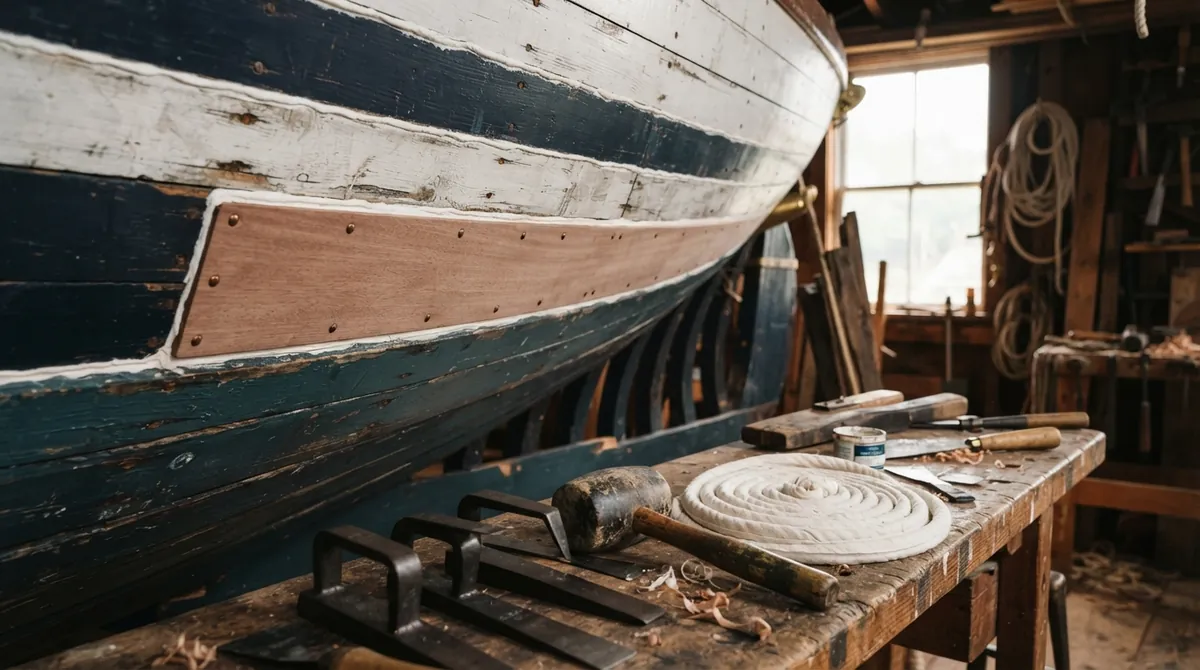
Late in the afternoon, when the sun comes in low through the open shed doors, a hull side shows things that are invisible at noon. A faint hollow behind a bulkhead, a ridge where two panels meet, a shallow wave along the sheer. The fairer crouches at the bow, sights along the surface with one eye closed, then runs a flat palm over it as if feeling for a pulse. On the floor lie the tools of the trade: long flexible boards, a tin of dark powder, a batten of clear-grained timber. This is slow work, and it shows.
Smooth is not the same as fair
A surface can be smooth to the touch and still not be fair. Fairing means making a surface true to its intended shape, so that it reflects light without waves and lets water flow over it cleanly. On topsides, the result is mostly visual: a fair hull carries the reflection of a quay or a horizon in long, unbroken lines. Below the waterline it is also about performance. Bumps and hollows on a keel or rudder disturb the flow, add drag and, on a performance yacht, cost speed and pointing ability.
Materials and tools
Modern fairing relies on epoxy fairing compounds, mixed from resin, hardener and lightweight fillers. They are light, fill well, stay stable once cured and sand comparatively easily. They are applied with notched trowels for an even thickness, or pulled across the surface with long screeds that span the hollows.
| Tool | What it does |
|---|---|
| Notched trowel | Spreads compound in even ridges of controlled thickness |
| Screed | A long straight or flexible blade pulled across the surface to strike off the excess |
| Longboard | A long, flexible sanding board that bridges the lows and cuts down the highs |
| Guide coat | A thin layer of contrasting colour or powder that reveals high and low spots |
| Batten | A flexible strip of timber or plastic bent along the hull to show uneven curves |
| Template | A profile cut to the designed section, used to check keels and rudders |
Of these, the longboard and the guide coat are the heart of the craft. A short sanding block simply follows the existing bumps. A long board, worked in diagonal, crossing strokes, rides over them and only removes material from the high points. The guide coat makes the result visible: where it sands away first, the surface is high, and where it stays, the surface is low and needs more compound.
A fair hull is one along which the eye can travel from bow to stern without ever stopping.
The order of work
Fairing is done in stages, and each stage needs time. Rushing it is the most common reason for a finish that looks perfect at launch and shows faint lines a few months later.
- Clean and key the surface, then check it with a batten and a raking light to map the lows and highs.
- Apply compound to the low areas with a notched trowel or screed, slightly proud of the final shape.
- Let it cure fully, according to the data sheet and the temperature, before any sanding.
- Apply a guide coat and sand with longboards in crossing diagonal strokes.
- Fill the remaining lows, cure again and repeat until the guide coat disappears evenly.
- Seal the faired surface with an epoxy primer before any paint or antifouling.
Compound that is sanded too early is still soft and shrinks as it goes on curing. The result is a filled area that sits slightly lower than its surroundings under the final paint, a ghost of the repair that appears once the hull has spent a few weeks in the sun. Patience at each stage costs far less than doing the topsides twice.
Keels and rudders: shaping a foil
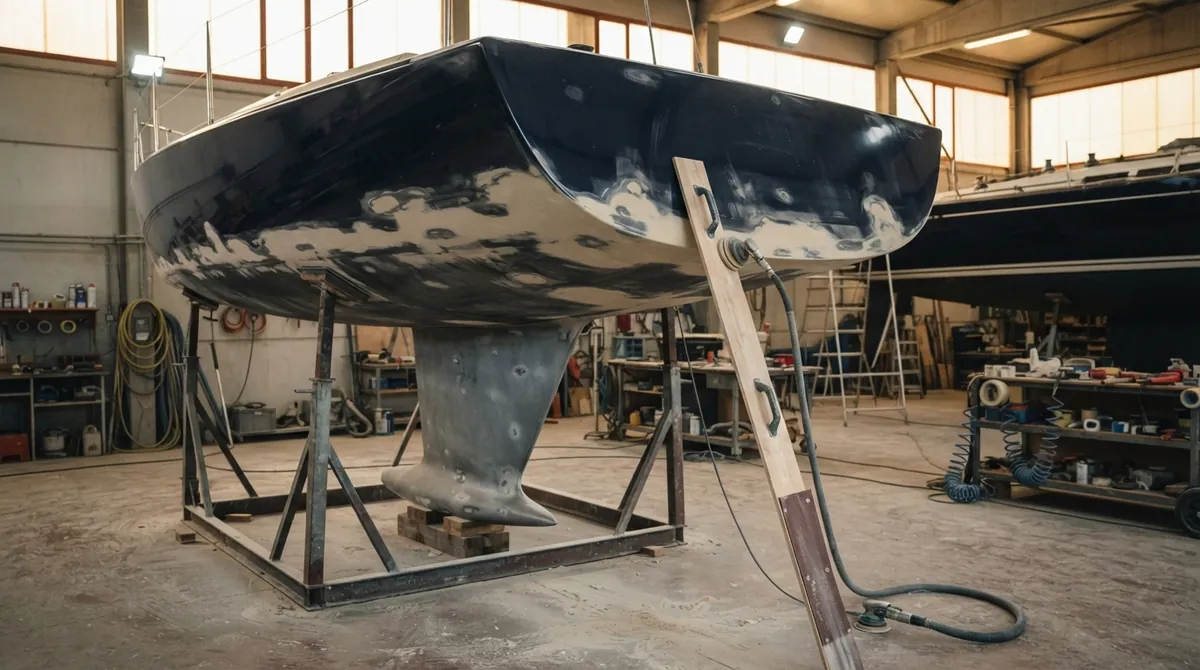
On performance yachts, keels and rudders are not just smoothed but shaped. Each is a foil, designed to a specific section that produces lift with as little drag as possible. Cast keels rarely leave the foundry with that exact shape, and years of groundings, repairs and layers of antifouling change it further.
To restore it, templates are made from the designer’s drawings for several stations along the keel or rudder, from root to tip. The fairer builds up and sands the surface until each template fits closely, with the same profile on both sides. The leading edge receives particular care, because its shape matters most for the flow, and the trailing edge is kept straight and crisp. On a cruising boat a less exacting approach is usually enough, but even there a fair, symmetrical keel and rudder make the boat steer more sweetly and hold her course with less effort.
Temperature, humidity and the shed
Epoxy compounds and primers depend on their surroundings. Cold slows the cure, sometimes so much that a compound stays soft for days. In cool, humid conditions some epoxies form a waxy film on the surface, known as amine blush, which must be washed off before the next layer. Condensation on a cold hull spoils adhesion. Good fairing is therefore best done under cover, in a shed where the temperature can be held within the range on the data sheet and the hull stays clearly above the dew point.
- Work within the temperature range of the compound and the primer.
- Wash off any amine blush before sanding or overcoating.
- Keep the hull dry and free of condensation.
- Allow longer cure times in cool weather rather than forcing the schedule.
- Keep dust from sanding away from areas that are still curing.
What it means for you as an owner
Fairing is skilled, time consuming work, and it makes the difference between a good paint finish and a superb one. When you compare offers for a repaint or a keel job, ask how the yard checks fairness, whether they use battens and templates, and how long they allow for curing between stages. A short schedule may look attractive on paper, but on a dark hull or a racing keel it will show. It is also worth asking how much compound is planned: a thin, even skin over a well built hull is a very different job from building up thick layers to correct a distorted panel.
Questions and answers
Why does my new paint show faint lines?
Often the fairing compound was sanded before it had fully cured and then shrank under the paint. Faint waves can also mean the surface was never checked properly with a guide coat and long boards.
Does a cruising yacht need its keel faired?
Not to racing standards, but a fair, symmetrical keel and rudder still reduce drag and improve steering. Repairing grounding damage and old layers of antifouling is usually worthwhile.
How long does fairing take?
It depends on the hull and the standard required, but it is always a matter of several stages with full cure times between them. Cool weather lengthens every stage.
Can fairing compound go straight under antifouling?
No. The faired surface is sealed with an epoxy primer first, and the antifouling follows the system’s instructions.
Our articles are general information written with care. Intervals and figures are guide values; the maker’s manual, your flag state, classification society and insurer take precedence, and safety critical work belongs with qualified professionals.