
Osmosis in GRP hulls: blisters, moisture readings and the long dry
Blisters below the waterline worry every owner of an older GRP yacht. How osmosis develops, how a surveyor reads the hull, and why the cure is mostly a matter of patience.
The smell gives it away before anyone says a word. A surveyor presses the point of a small knife into a blister the size of a fingernail, a drop of clear fluid runs down over the antifouling, and there is a faint, sharp note of vinegar in the cold air of the shed. Around the boat, the hull below the waterline is dotted with similar bumps, some no bigger than a lentil. For the owner it is an unsettling moment. For the surveyor it is the start of a careful process of reading what the hull has to say.
What actually happens inside the laminate
Gelcoat looks like a hard, waterproof shell, but over many years in the water it lets tiny amounts of water pass through. Behind it, in the laminate, that water finds substances that dissolve: traces of resin components that never fully cured, binders from the glass fibre mat and other water soluble residues from the building process. The solution that forms is more concentrated than the water outside, so more water is drawn in to dilute it. Pressure builds in small voids and between layers until the gelcoat lifts into a blister. The fluid inside is often acidic, which explains the smell.
Warm water and long periods afloat tend to speed the process up. Boats that stay in the water all year, especially in warmer seas, therefore often show it sooner than boats that spend every winter ashore.
Which hulls are at risk
Osmosis is most common in older hulls built with general purpose polyester resins, often with small air pockets left in the laminate during hand lay-up. Later building practice improved resistance considerably: isophthalic gelcoats and skin coats, and vinylester resins in the outer layers, take up far less water. No GRP hull is completely immune, though, and the quality of the original lamination matters as much as the resin type.
- Older hulls built mainly with general purpose polyester resin
- Hulls that have spent many years afloat without long periods ashore
- Boats kept in warm water or fresh water, where the process often runs faster
- Laminates with dry spots, voids or poorly wetted glass
- Hulls where earlier blisters were simply filled without drying the laminate
Diagnosis: readings, blisters and judgement
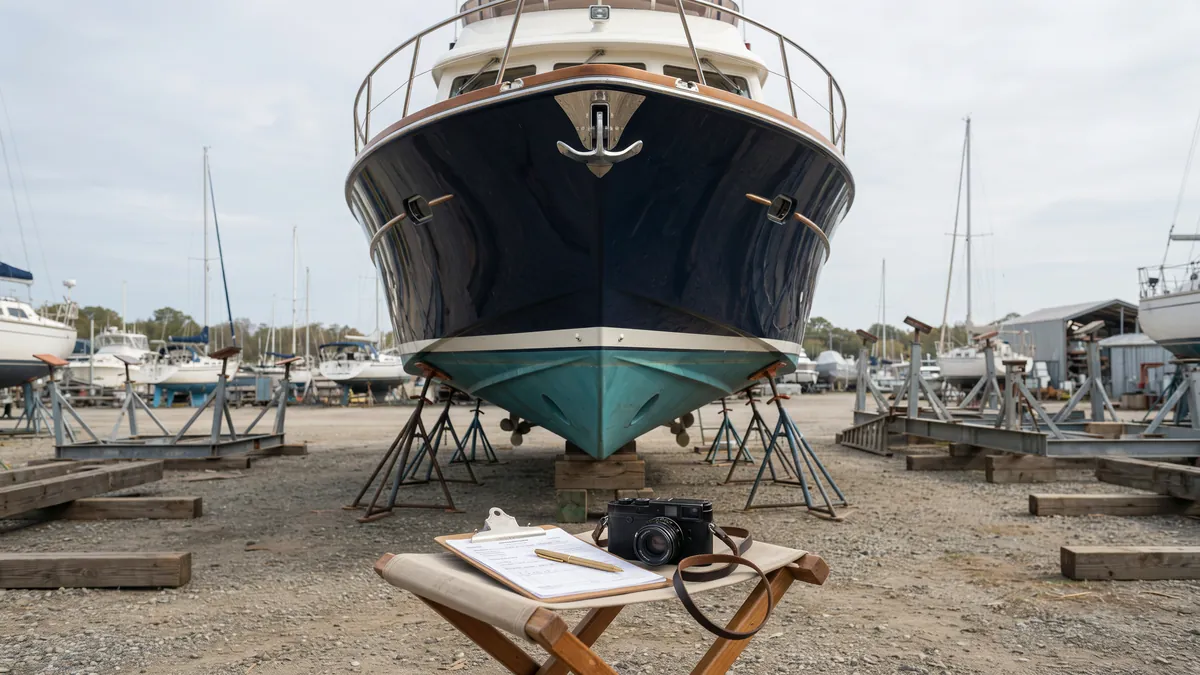
A proper assessment starts as soon as the boat comes out of the water, before the surface has had a chance to dry. The surveyor looks for blisters, notes their size and distribution, and may open a few to check the fluid and the depth of the damage. A moisture tester is then passed over the hull, both below and above the waterline.
Those readings need careful interpretation. The instrument gives comparative values, not a laboratory measurement of water content. A reading means most when it is compared with dry areas of the same hull, such as the topsides, taken with the same instrument and in similar conditions. Antifouling with metal content, a wet surface and cold weather can all distort the numbers. That is why the surveyor’s judgement, built on what they see, feel and measure together, carries more weight than any single figure.
A moisture reading on its own means little; the story is told by the comparison.
Is it dangerous?
In most cases, osmosis is a cosmetic and value issue rather than an immediate danger. A hull with scattered small blisters is not about to fail at sea. It matters when you sell or buy, because a surveyor will report it and buyers will take treatment into account. Advanced cases are different. When blisters run deep, when layers of laminate begin to separate or when the glass itself has been attacked, the strength of the hull can be affected, and the treatment becomes a structural repair rather than a cosmetic one.
The treatment, step by step
A full osmosis treatment is a project measured in months rather than days, and it fits most naturally into a winter ashore.
- Removing the gelcoat: the underwater gelcoat is peeled off with a planing machine or taken off by careful blasting, opening up the laminate beneath.
- Washing out: the exposed laminate is washed repeatedly with fresh water or steam to flush out the water soluble substances.
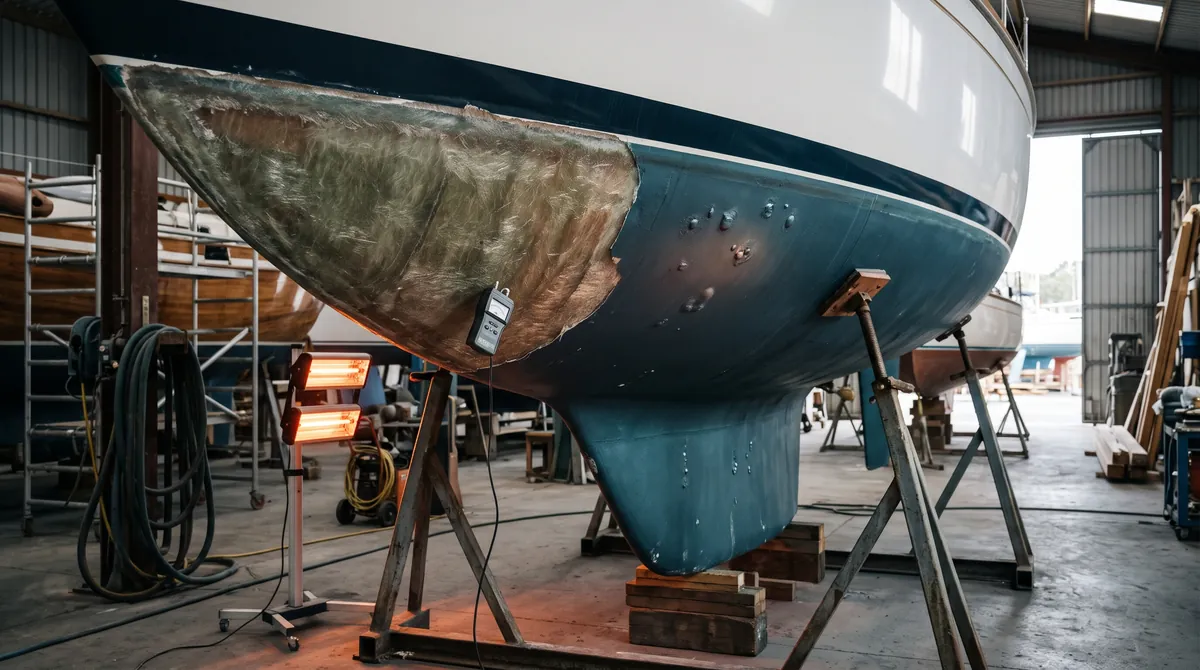
- Drying: the hull dries for weeks or months, often in a dehumidified tent or under infrared heaters, while readings are taken at fixed points.
- Repairing the laminate: damaged or delaminated areas are ground back and rebuilt with new glass and resin.
- Fairing: the surface is filled and faired back to a smooth, true shape.
- Barrier coat: several coats of epoxy barrier coat are applied to the specified film thickness.
- Antifouling: only once the barrier coat has cured as specified does the antifouling follow.
The long dry
The drying phase is where patience pays. Washing is often repeated during drying, because fluid continues to weep from the laminate for some time, leaving small damp spots and crystals on the surface. The readings at each marked point are recorded and followed over the weeks. A good yard does not seal the hull because the calendar says so, but because the readings have levelled off and stayed stable. Sealing a laminate that is still wet simply traps the problem under fresh epoxy.
| Phase | Typical duration | What decides the end |
|---|---|---|
| Gelcoat removal | A few days | The whole affected area is opened evenly |
| Washing | Repeated over several weeks | No more fluid weeping from the laminate |
| Drying | Weeks to months | Stable readings at the fixed points |
| Repair, fairing and barrier coat | Several weeks | Cure times and film thickness reached |
Guide values only; the season, the laminate and the drying method all change the timeline.
Prevention: barrier coats and time ashore
On a new hull, or one that has been dried thoroughly, an epoxy barrier coat below the waterline greatly reduces the water uptake that starts osmosis. Applying it to a hull that is already wet, however, can lock the moisture in. Beyond that, simple habits help: a period ashore each year lets the laminate breathe out, and a dry bilge stops water working on the laminate from the inside. Once a hull has been properly treated, it is often in better condition below the waterline than on the day it left the builder’s mould.
Questions and answers
Can I still sail a boat with osmosis blisters?
In most cases yes, because small scattered blisters rarely affect strength. Have a surveyor assess their depth and extent, and plan treatment if the laminate is affected or the blisters are spreading.
How long does an osmosis treatment take?
Expect weeks to months, mostly because of the drying phase. The end is decided by stable readings, not by a fixed date, so a winter ashore is often the natural window.
Will a treated hull get osmosis again?
A properly dried hull with a correctly applied epoxy barrier coat is well protected. The quality of the drying and of the barrier coat decides how long that protection lasts.
Should I avoid buying a boat with osmosis?
Not necessarily. Commission a pre-purchase survey, find out how advanced the problem is and take the treatment into account when you negotiate.
Our articles are general information written with care. Intervals and figures are guide values; the maker’s manual, your flag state, classification society and insurer take precedence, and safety critical work belongs with qualified professionals.