
Steel hulls: blasting, coatings and the fight against rust
A steel hull forgives a great deal, except neglect of its coating. How a steel yacht is inspected, blasted, primed and protected, inside as well as out.
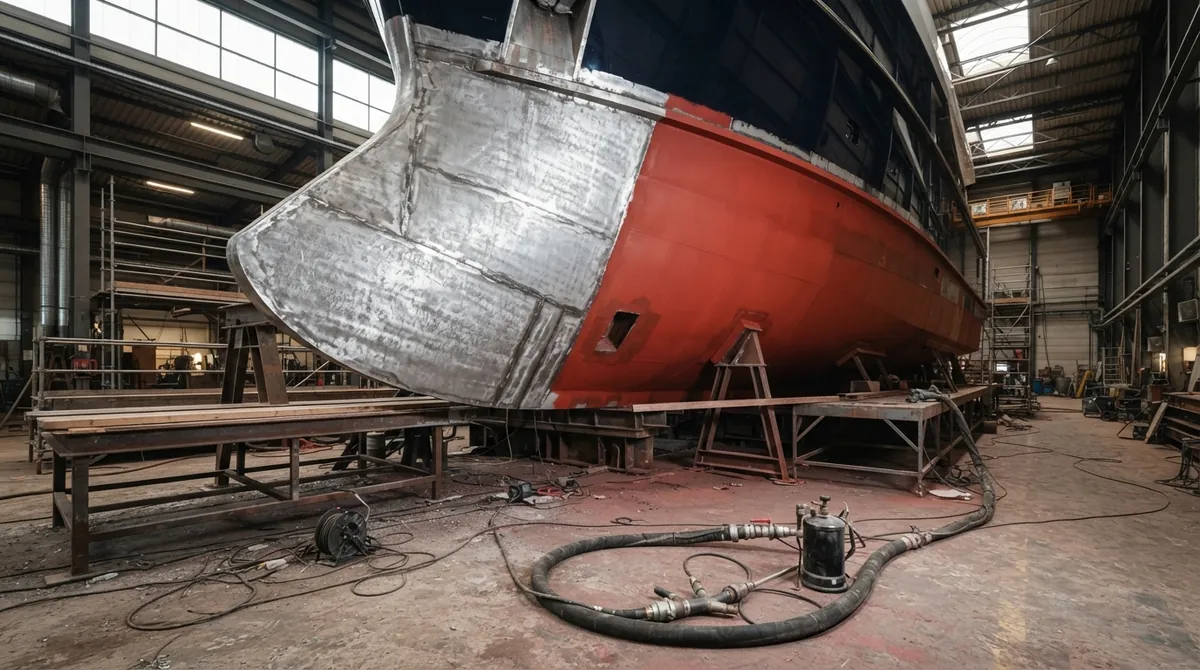
In the blasting hall, the noise is total and the air is thick with grit. When the operator finally lifts the nozzle and the dust settles, the hull plating has changed colour: not the orange of rust or the tired grey of old paint, but an even, matt silver-grey that seems to glow under the lights. It will not stay that way for long. In moist air a thin bloom of flash rust can appear within hours, so the priming crew are already waiting, equipment ready, for the moment the hall is clear.
Why owners choose steel
Steel is strong, tough and repairable. It dents rather than shatters on impact, which is why it has long been favoured for expedition yachts, long distance cruisers and many larger motor yachts. Damage can be cut out and new plate welded in by a competent yard in most parts of the world. The price of these virtues is constant attention to corrosion. Bare steel in sea air and salt water rusts, and the whole life of a steel hull depends on how well its coating keeps water and oxygen away from the metal.
Inspection: measuring what you cannot see
Rust on the outside of a steel hull is usually obvious. The more important question is how much steel is left. Ultrasonic thickness measurements answer it: a surveyor takes readings at many points over the hull, compares them with the original plate thickness and maps any areas of wastage.
- Pitting: small, deep craters, often under failed coatings or around the waterline.
- Rust behind insulation: hidden corrosion where condensation has collected behind linings and foam.
- Bilges and tanks: areas where water stands, under tanks and engine beds, and in the chain locker.
- Condensation: damp patches or drips inside the hull, a sign that insulation or ventilation is not working.
- Weld seams and edges: places where coatings are naturally thinner and tend to fail first.
Inside the boat, inspection is the harder part, because linings and furniture hide the plating. A thorough survey opens access panels wherever possible and pays particular attention to the lowest points of the hull, where water and debris collect.
Surface preparation: blasting to a defined grade
A coating on steel is only as good as the surface beneath it. Abrasive blasting removes rust, mill scale and old coatings and leaves a rough profile that gives the primer something to grip. The result is described by cleanliness grades under ISO 8501-1. For a yacht hull, Sa 2.5 is a common target: very thorough blast cleaning that leaves no more than slight traces of staining on the surface.
The clock starts as soon as blasting stops. Freshly blasted steel is very reactive, and in humid air flash rust forms quickly. Priming must follow fast, usually within the same working day, while the steel is clean, dry and well above the dew point. Good yards blast and prime in sections they can finish, rather than leaving large areas of bare steel overnight.
On a steel boat, the coating is not decoration but the first line of the structure.
The coating system and its thickness
A modern steel hull is protected by a system of layers, each with a clear role. The data sheets specify the products, the overcoating intervals and above all the dry film thickness, which is measured with a gauge after each coat.
| Layer | Role | What to check |
|---|---|---|
| Epoxy primer | Bonds to the blasted steel and stops early corrosion | Applied promptly after blasting, at the right thickness |
| Epoxy build coats | Form a thick barrier against water and oxygen | Several coats to the specified total thickness |
| Fairing, where used | Smooths plating and weld seams on visible areas | Applied over primer and sealed again |
| Topcoat | Colour, gloss and protection from sunlight above the waterline | Compatible with the epoxy system |
| Antifouling | Prevents fouling below the waterline | Over the specified tie coat, never on an unsuitable base |
Guide only; the coating system’s data sheets set the exact build-up.
Too thin a coating lets moisture through; too thick a single coat can trap solvent and crack. Measuring dry film thickness takes a few minutes per area, and a yard that records it carefully is usually a yard that takes steel seriously.
Edges, welds, bolt holes and brackets deserve extra attention. Paint pulls away from sharp edges as it dries and is naturally thinner over weld beads, which is why careful yards brush an extra stripe coat along them before each full coat. Corners and the backs of stiffeners that are hard to reach with a spray gun are treated the same way. These are exactly the places where rust usually breaks through first, so a few extra minutes with a brush here repay themselves for years.
Repairs: insert plates and welding
Where the readings show plating that has wasted beyond acceptable limits, the steel is cut out and a new insert plate is welded in. This is work for qualified welders, ideally under the eye of a surveyor, with attention to plate thickness, weld quality and distortion of the surrounding hull. Afterwards, the repaired area needs the full coating system again, from preparation to topcoat, with special care at the weld seams, where coatings are naturally thinner.
Below the waterline, sacrificial anodes add a second line of defence by corroding in place of the steel wherever the coating has been damaged. Their choice and care are a subject of their own, but on a steel hull they must never be forgotten, and never painted over.
The inside: condensation and dry bilges
Many steel boats corrode faster from the inside than from the outside. Warm, moist air in the accommodation meets cold plating and condenses, and if that water runs down behind the linings it can sit there unseen for years. Good insulation, applied directly to well coated steel, and steady ventilation reduce condensation greatly. In the bilge, limber holes must stay clear so that water can reach the pump, and the bilges themselves should be kept clean and dry, free of oily residue and debris that hold moisture against the steel.
Questions and answers
How often should a steel hull be thickness tested?
There is no single rule, but ultrasonic measurements are commonly part of a pre-purchase survey and of major refits. The classification society, the flag state or the insurer may set their own requirements.
What does Sa 2.5 mean?
It is a cleanliness grade for blast cleaned steel under ISO 8501-1, describing very thorough blasting with only slight traces of staining left. It is a common target for yacht hulls before coating.
Why does rust appear again so quickly after blasting?
Freshly blasted steel is very reactive and forms flash rust in moist air. That is why priming must follow quickly, on clean, dry steel above the dew point.
Can I weld a repair myself?
Structural repairs to a steel hull belong in the hands of qualified welders, ideally with a surveyor involved. The repaired area then needs the full coating system again.
Further reading in our network
- RanerisSuperyachts and charter
Superyachts and charter, among them the large steel yachts whose hulls rely on exactly this kind of patient care.
Our articles are general information written with care. Intervals and figures are guide values; the maker’s manual, your flag state, classification society and insurer take precedence, and safety critical work belongs with qualified professionals.