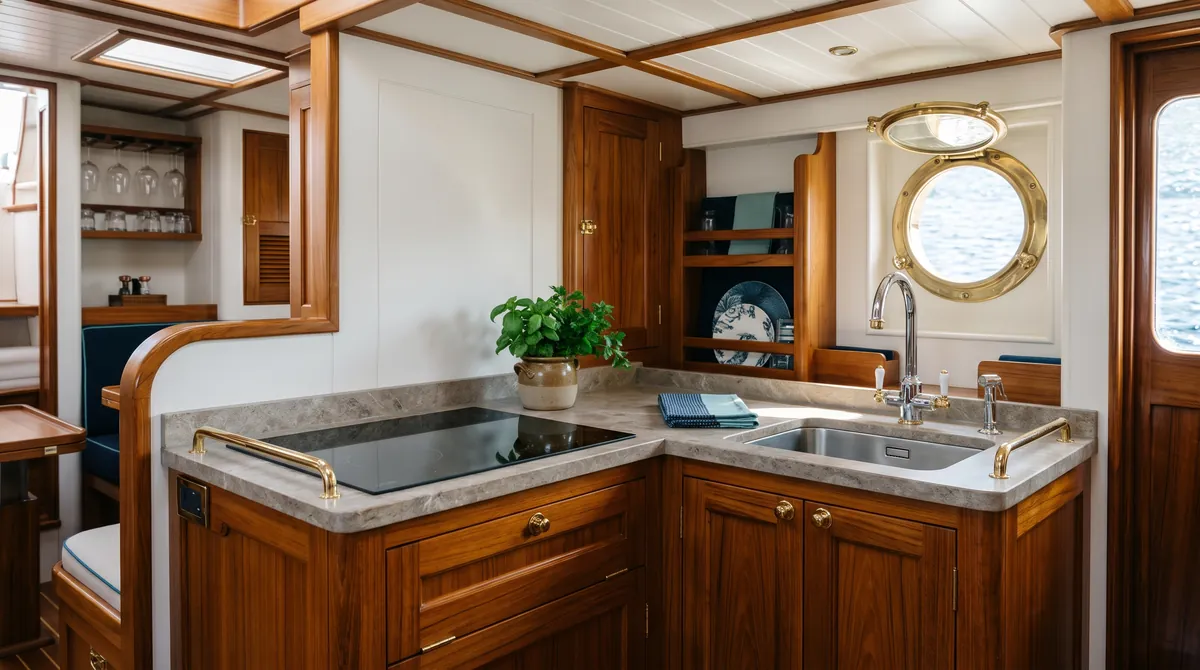

Galley and heads refit: gas, induction, toilets and holding tanks
The two smallest rooms on board decide much of the comfort and a good part of the safety. What to consider when gas lines, cookers, toilets and tanks are renewed.
At anchor in the early morning, the galley is the heart of the yacht: the hiss of a kettle, the smell of coffee drifting up the companionway, someone reaching past the cook for a mug. The heads, a few steps forward, are noticed mostly when something is wrong, and the first sign is almost always a faint smell that no amount of cleaning removes. Both rooms are small, both work hard, and both hide systems that need proper design. A refit is the moment to get them right.
Start with how you live on board
Before choosing appliances, think about how the galley is used. Do you cook full meals at sea, or mostly in harbour? Do you spend weeks at anchor, away from shore power? How many people eat on board, and how often? The answers decide whether gas or electric cooking makes sense, how large the refrigeration should be and how much fresh water and hot water you need. A galley designed around real habits works better than one designed around a showroom photograph.
LPG done properly
Liquefied petroleum gas remains the most common cooking fuel on yachts, and it is safe when the installation is right and the habits are good. Because the gas is heavier than air, any leak sinks into the bilge, where it can collect unseen. Every element of a good installation follows from that fact. Gas work belongs in the hands of a qualified gas fitter who knows the rules for small craft in your country, and the installation should be checked regularly.
- A gas locker for the cylinders, sealed from the interior and draining overboard above the waterline.
- A solenoid shut off valve at the cylinder, switched from the galley, so the supply can be closed after each use.
- A gas detector with its sensor low in the boat, where leaking gas would collect.
- Approved hoses and fittings, with hoses renewed by the date marked on them or at the interval the installer gives.
- Regular leak checks of the whole system, and a firm habit of closing the supply when cooking is finished.
Induction and the battery bank behind it
Induction cooking has become a real alternative on yachts with a large lithium battery bank and an inverter that can supply the hob. It removes gas from the boat entirely, keeps the galley cooler and is easy to clean. The cooker itself is the simple part. The real design work lies in the battery capacity, the inverter, the cabling and the charging sources that refill the bank, whether alternator, generator, solar or shore power. That is a job for a qualified marine electrician and belongs in the electrical plan of the refit rather than in the galley plan alone.
| Aspect | LPG cooking | Induction cooking |
|---|---|---|
| Energy source | Gas cylinders in a locker draining overboard | Large battery bank with inverter, recharged on board or ashore |
| Safety focus | Leaks, ventilation, detector, shut off valve | Correct fusing, cabling and battery management |
| At anchor | Independent of the batteries | Depends on charging capacity over the day |
| In the cabin | More heat and moisture from combustion | Cooler galley, no combustion products |
| Cookware | Most pans suitable | Pans must be suitable for induction |
Cold and hot: refrigeration and fresh water
Refrigeration on board lives or dies by its insulation. A well insulated box needs far less energy than a poorly insulated one with a larger compressor, so a refit is a good moment to improve insulation around fridge and freezer. The compressor needs ventilation too: a unit installed in a closed locker without airflow runs longer, uses more power and wears faster.
The fresh water system usually includes a pressure pump, an accumulator that smooths the pressure and spares the pump from switching on and off constantly, and a calorifier, the water heater warmed by the engine’s cooling circuit and by an electric element on shore power. Check hoses, clamps and fittings, renew tired pumps, and make sure the calorifier has a working pressure relief valve and is well secured in its place.
Heads: manual, electric or vacuum
Marine toilets come in three broad types. Manual toilets are simple, reliable and easy to repair with a small service kit. Electric toilets are more comfortable for guests and use the pump at the push of a button, but they draw current and add a motor that can fail. Vacuum toilets use little flushing water, which saves space in the holding tank, and they are common on larger yachts. Whichever you choose, the installation around it matters more than the bowl itself.
A smell in the heads is rarely a cleaning problem; it is usually a hose problem.
Hoses, loops and valves
Ordinary hose lets odour molecules pass through its wall over time, which is why so many older yachts smell faintly of their heads. Sanitation hose made to resist odour permeation is the remedy, and a refit is the time to renew every run, using as few joints and as short a route as possible. Where the toilet sits near or below the waterline, anti siphon loops with vented tops must be fitted in the inlet and discharge lines, high enough above the waterline at every angle of heel, to stop sea water siphoning back into the boat. Y valves direct waste either to the holding tank or overboard, and they should be clearly marked and secured in the position local rules require.
Holding tanks and the rules of the coast
Many countries and sea areas forbid discharging toilet waste near the coast and in harbours, and a holding tank is increasingly expected on cruising yachts. A good installation has a tank of suitable material and size, a deck pump out fitting for emptying at shore facilities, a vent line with a filter to control smells, and a gauge or level indicator. Rules differ widely between regions and change over time, so check the local requirements for the waters you plan to sail, and ask the yard to size the tank around them.
Easy to clean, easy to breathe
Comfort in galley and heads depends on details. Smooth, sealed surfaces without open joints are easy to wipe clean. Opening ports or hatches, or extraction fans, keep steam and moisture out of the rest of the yacht. A bilge sump under a shower drains through a pump rather than into the main bilge. Good lighting, a handhold for heavy weather and a door that latches open and closed make small rooms safer at sea. None of this is complicated, but all of it is much easier to build in during a refit than to add later.
Questions and answers
Is gas or induction better for a yacht galley?
It depends on how you use the boat. Gas is independent of the batteries and familiar to most cooks. Induction removes gas from the yacht but needs a large battery bank, an inverter and reliable charging.
Why do my heads smell even when they are clean?
Usually because the hoses have become permeable and let odour pass through their walls. Replacing them with sanitation hose made to resist odour permeation normally solves the problem.
Do I need a holding tank?
In many countries, sea areas and harbours, discharge of toilet waste is forbidden near the coast, so a holding tank is often required or expected. Check the rules for the waters you sail.
How often should gas hoses be replaced?
Follow the date marked on the hose and the interval given by your installer or local rules. Hoses age even when they look fine, so renew them in good time and have the system checked regularly.
Further reading in our network
- MurosoArchitecture and interiors
Architecture and interiors, with ideas for kitchens and bathrooms that inspire small spaces on board.
Our articles are general information written with care. Intervals and figures are guide values; the maker’s manual, your flag state, classification society and insurer take precedence, and safety critical work belongs with qualified professionals.


