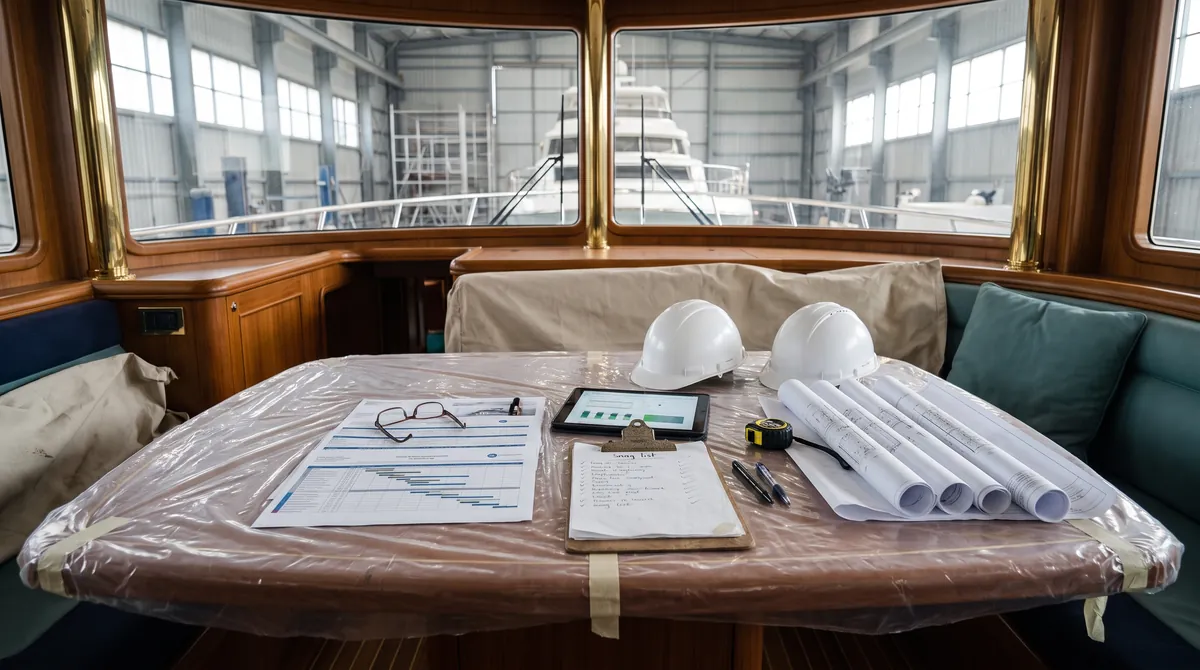

Refit project management: meetings, change orders and the snag list
A refit is steered week by week, not at the start and the end. The quiet tools that keep scope, schedule and quality on course, and who should hold them.
Monday morning, half past eight, in a portable office beside the shed. The yard’s project manager has a printed schedule on the table, the captain has a folder of photographs from last week, the electrician arrives with a coffee and a question about a cable route. In forty minutes they go through every open item, agree two small changes, and note who will do what before Friday. Nothing dramatic happens. That is exactly the point: a well managed refit is a long series of small, recorded decisions.
Who holds the reins
Every refit needs one person on the owner’s side who has the authority to decide and the time to be present. On smaller yachts that is often the owner, if the yard is within reach and the owner enjoys the process. On yachts with a permanent crew it is usually the captain, who knows the boat better than anyone. For larger or more complex projects, many owners appoint an independent project manager or owner’s representative: a professional who reads drawings, understands the trades and speaks the yard’s language.
Whoever it is, put the arrangement in writing. The yard needs to know whose signature counts on a change order, who may visit the shed and who receives the reports. Two people on the owner’s side giving different instructions to the same painter is one of the surest ways to lose time and goodwill.
A schedule with milestones, not just dates
A schedule is only useful if progress can be measured against it. Break the refit into milestones that can be seen and checked: yacht hauled and stripped, structural repairs complete and inspected, systems installed and tested, interior refitted, paint complete, launch, sea trials. Each milestone should describe a state of the yacht, not a period of time. When milestones slip, the reason is usually visible weeks earlier in the meeting minutes, which is why both belong together.
Weekly meetings and the minutes that matter
Weekly progress meetings, ideally on board or beside the yacht, keep the project honest. Walk the boat first, then sit down. Keep the minutes short and consistent: one line per open item, referenced to the specification number, with a decision, a responsible person and a date. Circulate them the same day and ask everyone to point out mistakes before the next meeting. Over months, these pages become the true history of the refit.
Between meetings, photo reports carry the story. Ask the yard for regular photographs of work in progress, filed by specification item. For an owner who is far away, a weekly set of well chosen images often says more than any written report.
Good communication on a refit matters more than any software, and a clear page of minutes is worth more than a clever project tool.
Change orders: nothing new without paper
Changes are normal. Old joinery reveals rot, a new idea strikes the owner on a visit, an engineer finds a better route for an exhaust. The rule is simple and should be in the contract: every addition or alteration is described in a written change order before the work starts. A good change order states the item it changes, what will be done, the effect on price and on schedule, and who approves it. Signed, it is filed with the specification and the item is updated.
The discipline protects both sides. The yard is paid for real extra work, and the owner sees the consequences of each decision while there is still time to say no. Verbal changes agreed on the shed floor are where final invoices and friendships most often come apart.
Inspection and test plan for critical items
Some work cannot be checked once it is covered. An inspection and test plan lists those critical items and defines, for each one, what is inspected or tested, when, by whom and against which criteria. It may include the opened keel joint, a repaired laminate before fairing, the film thickness of a coating system, a pressure test of fuel or water lines, insulation tests on new wiring, and the engine alignment. Hold points mean that work stops until the check is done and signed. Witness points mean the owner’s side is invited but work may proceed if nobody comes.
The snag list and payments by milestone
A snag list, often called a punch list, records every defect or unfinished detail: a scratch on new varnish, a cupboard door that does not close, a light that flickers. Start it early and keep it running rather than writing one enormous list at the end. Each snag gets a number, a location, a photograph and a responsible trade, and it is closed only when the owner’s side has seen the fix. The list must be closed, or each remaining point formally agreed, before handover.
Payments work best when they follow the work. Tie each instalment to a completed milestone rather than to a date on the calendar, and keep a final payment for the closed snag list and the documentation. It keeps attention where it belongs as the project nears its end.
Safety on site and the protection of finished work
Refit sheds hold solvents, dust, fuel and fresh coatings, and fire is the risk everyone remembers. Insist on hot work permits for welding, grinding and cutting, with a fire watch during and after the work and extinguishers within reach. Agree how finished surfaces are protected: film on varnish, padding on cap rails, hard covers on new soles, clean shoe rules inside the yacht. A dropped tool on a new sole can undo days of work, so protection is part of the schedule, not an afterthought.
The papers that end the project
A refit is complete when the yacht is finished and the documentation is handed over. Agree the contents of that documentation pack at the start, so that it is built up during the works rather than assembled in a hurry at the end.
- Updated wiring and plumbing diagrams that show the yacht as she is now.
- Manuals and installation records for all new or serviced equipment.
- Warranty certificates with start dates and conditions.
- Paint system records: products by type, coats, film thickness and dates.
- A list of hidden work with photographs, referenced to its location.
- The final specification with all change orders and the closed snag list.
Questions and answers
Do I need an independent project manager?
Not for every refit. An engaged owner or an experienced captain can manage a modest project well. For complex works, long distances or a yacht without permanent crew, an owner’s representative often pays for the time and stress saved.
What should a change order contain?
The specification item it affects, a description of the work, the effect on price and schedule, and the signature of the person authorised to approve it. It should be signed before work starts, not afterwards.
What is the difference between a hold point and a witness point?
At a hold point, work stops until the agreed inspection has taken place and been signed. At a witness point, the owner’s side is invited to watch, but work may continue if nobody attends.
When should the snag list be started?
As soon as the first finished surfaces appear. A running list, reviewed weekly, catches defects while the responsible trade is still on site and avoids a long, contested list at the end.
Further reading in our network
- conciarisLuxury concierge and lifestyle
Luxury concierge and lifestyle, for owners who prefer to hand over the details of yacht projects and travel to trusted hands.
Our articles are general information written with care. Intervals and figures are guide values; the maker’s manual, your flag state, classification society and insurer take precedence, and safety critical work belongs with qualified professionals.


